


Why Is My Resume Getting Rejected? 10 Common Mistakes That Stop You from Getting Interviews
 Jul 24,2026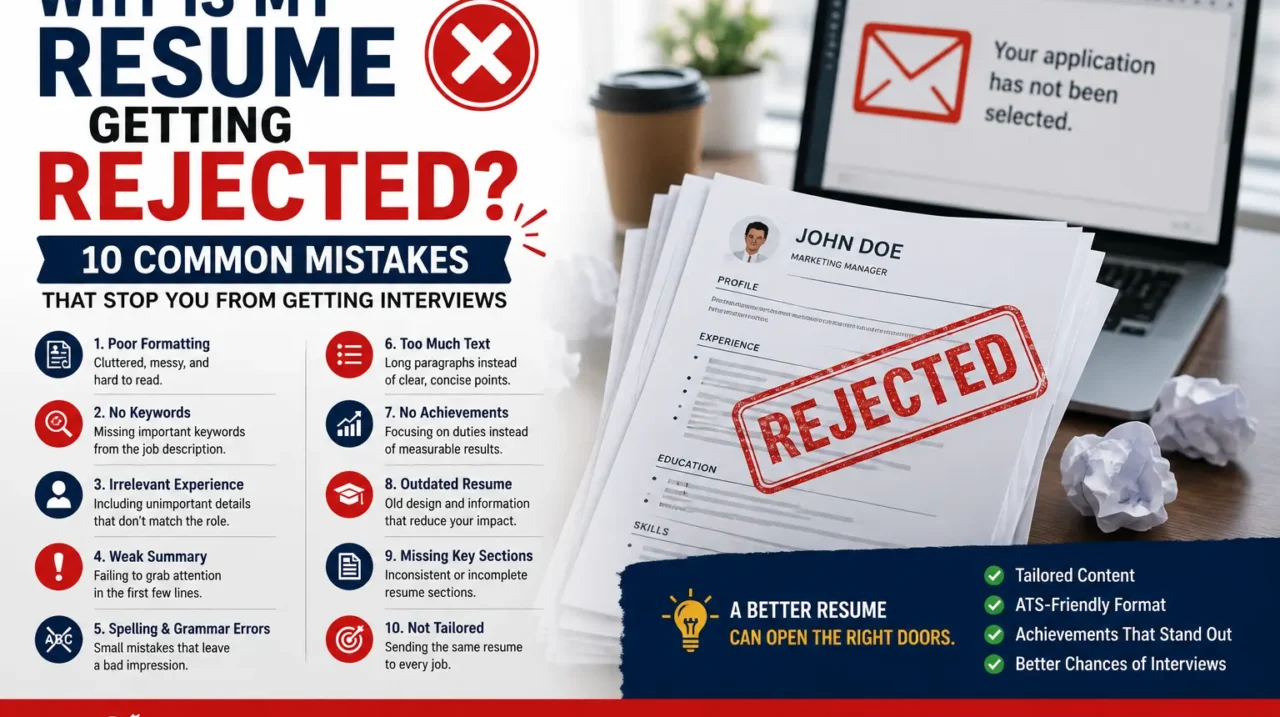
Why Is My Resume Getting Rejected?
You spend hours searching for the right jobs, carefully submit your applications, and wait hopefully for a response. Days turn into weeks, yet your inbox remains silent. If this situation sounds familiar, you’re probably asking yourself one question:
“Why is my resume getting rejected?”
It’s a frustrating experience, especially when you know you have the qualifications and experience required for the role.
The surprising truth is that many resumes are rejected before a recruiter even has the chance to evaluate the candidate’s abilities.
In today’s competitive hiring environment, employers often receive hundreds of applications for a single vacancy. To manage this volume, companies rely on structured recruitment processes and Applicant Tracking Systems (ATS) to filter applications before they reach hiring managers.
This means your resume has to do much more than simply list your work history.
It needs to clearly demonstrate your value, highlight relevant achievements, match the employer’s requirements, and present information in a way that’s easy for both technology and recruiters to understand.
The good news is that most resume rejections happen because of common, fixable mistakes not because you’re unqualified.
Once you understand what recruiters actually look for, you can make meaningful improvements that increase your chances of getting shortlisted.
Why Is My Resume Getting Rejected?
Your resume may be getting rejected because it isn’t tailored to the job, lacks relevant keywords, focuses on responsibilities instead of achievements, contains formatting issues, or isn’t optimized for Applicant Tracking Systems (ATS). Improving these areas can significantly increase your chances of getting interview calls.
Why Resume Rejections Are More Common Than You Think
Many job seekers assume that resume rejection means they don’t have enough experience or qualifications.
In reality, that’s often not the case.
Recruiters regularly receive applications from highly qualified candidates whose resumes simply fail to communicate their strengths effectively.
Sometimes the experience is impressive, but the achievements are hidden.
Sometimes the skills are relevant, but they aren’t presented using language that matches the job description.
In other cases, the resume is difficult to read or fails to pass ATS screening altogether.
At JobApplyExpert, we’ve reviewed resumes from professionals across Information Technology, Healthcare, Finance, Engineering, Marketing, Human Resources, Sales, and Operations. One pattern appears consistently many candidates underestimate the importance of how they present their experience.
A resume isn’t just a record of your career.
It’s a marketing document that should convince employers why you’re the right person for the position.
Did You Know?
Modern recruitment has changed significantly over the last decade.
Many medium and large organizations use Applicant Tracking Systems (ATS) to organize and screen applications before recruiters review them.
Recruiters also receive a large number of applications for every advertised role, making it essential for resumes to communicate relevant qualifications quickly and clearly.
A professionally structured resume helps improve readability for both ATS software and human recruiters, increasing the likelihood that your application progresses to the next stage.
What Recruiters Really Want to See
Before inviting a candidate for an interview, recruiters typically look for evidence that answers a few important questions:
- Does this candidate have relevant experience?
- Are their skills aligned with the job requirements?
- Have they demonstrated measurable achievements?
- Is the resume clear, professional, and easy to understand?
- Does the application show attention to detail?
If recruiters cannot find these answers quickly, they often move on to the next application.
This doesn’t necessarily mean you’re unqualified.
It simply means your resume isn’t presenting your qualifications effectively.
10 Common Resume Mistakes That Stop You from Getting Interviews
Understanding why your resume is getting rejected is the first step toward improving your job search. Most resumes are not rejected because candidates lack skills or experience. Instead, they are rejected because they fail to communicate those strengths in a way that recruiters expect.
Here are the ten most common mistakes that prevent qualified professionals from getting interview calls and more importantly, how you can avoid them.
1. You’re Sending the Same Resume for Every Job
Quick Answer
Using one resume for every application reduces your chances of getting shortlisted because every employer looks for different skills, qualifications, and experience.
Many job seekers believe that once they’ve created a resume, they can use it for every application. While this approach saves time, it rarely delivers good results.
Every job description is different. Even two companies hiring for the same role may prioritize different skills or responsibilities.
For example, one employer may be looking for someone with leadership experience, while another may value technical expertise or client communication.
A Professional Resume should be customized for each application by updating the professional summary, emphasizing relevant achievements, and naturally incorporating important keywords from the job description.
Customizing your resume doesn’t mean rewriting everything from scratch. Small adjustments can make your application much more relevant and improve your chances of passing ATS screening.
2. Your Resume Isn’t ATS-Friendly
Quick Answer
An ATS-friendly resume is easier for Applicant Tracking Systems to read, helping your application reach recruiters instead of being filtered out during the initial screening process.
Many employers use Applicant Tracking Systems (ATS) to manage the large number of applications they receive.
If your resume contains complex tables, graphics, icons, multiple columns, or unusual fonts, the ATS may struggle to read your information correctly.
A professional resume uses:
- Clear section headings
- Standard fonts
- Simple formatting
- Relevant keywords
- Logical structure
These small formatting choices help ensure that your qualifications are accurately processed before your resume reaches a recruiter.
3. You Describe Responsibilities Instead of Achievements
Quick Answer
Recruiters are more interested in the results you’ve delivered than a list of daily responsibilities.
One of the most common reasons resumes fail to stand out is that they simply describe job duties.
Recruiters already know what a Sales Executive, Software Engineer, Accountant, or HR Executive typically does.
What they want to know is:
What impact did you make?
Instead of writing:
“Handled customer support requests.”
Consider writing:
“Resolved customer concerns efficiently while maintaining a high customer satisfaction rate and improving response times.”
Achievement-focused statements help recruiters understand your contribution and demonstrate the value you can bring to a new organization.
4. Your Professional Summary Is Too Generic
Quick Answer
A strong professional summary should explain who you are, what you specialize in, and the value you bring to an employer.
Many resumes begin with statements like:
“Hardworking professional seeking a challenging opportunity.”
Unfortunately, these introductions tell recruiters very little.
Instead, your professional summary should provide a clear overview of your experience, core strengths, and career achievements.
Think of it as your introduction during an interview.
It should immediately answer the question:
Why should an employer continue reading your resume?
A compelling summary encourages recruiters to explore the rest of your application.
5. Your Resume Is Difficult to Read
Quick Answer
A well-structured resume improves readability, allowing recruiters to quickly find the information they need to evaluate your application.
Imagine reviewing hundreds of resumes in a single day.
Recruiters naturally spend more time on resumes that are organized, clear, and easy to follow.
Common readability problems include:
- Long paragraphs.
- Inconsistent formatting.
- Excessive colours.
- Small font sizes.
- Too much unnecessary information.
A professional resume uses consistent formatting, clear headings, balanced white space, and concise content that guides the reader naturally through your career journey.
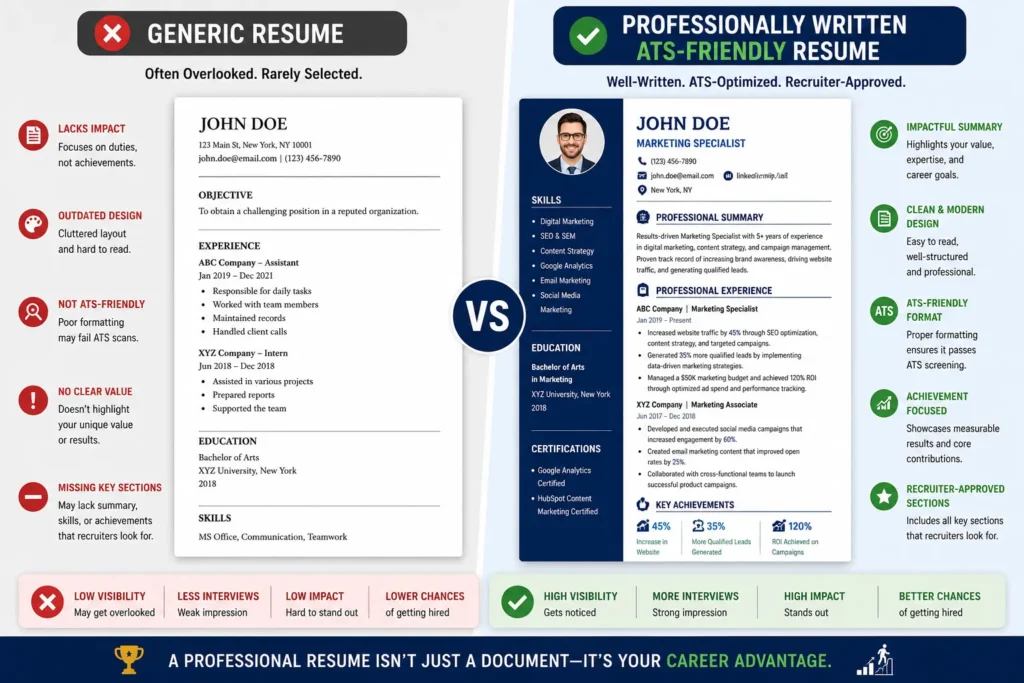
Resume Comparison
| Resume That Gets Rejected | Professional Resume |
| Same resume used for every application | Tailored for every job opportunity |
| Lists responsibilities | Highlights measurable achievements |
| Poor formatting | Clean and recruiter-friendly layout |
| Missing ATS keywords | Optimized with relevant industry keywords |
| Difficult to scan | Easy to read and professionally structured |
| Generic summary | Personalized professional introduction |
This comparison highlights that the difference isn’t necessarily your experience it’s how effectively you communicate that experience.
Industry Insight
Recruiters often review a large number of applications for every open position. Because of this, resumes that clearly communicate relevant skills, measurable achievements, and role-specific experience are more likely to progress to the next stage of the hiring process. A resume that is tailored to the job description and follows ATS-friendly formatting standards gives recruiters the information they need quickly and efficiently.
Expert Insight
At JobApplyExpert, we’ve worked with job seekers from a wide range of industries, including IT, Finance, Healthcare, Engineering, Marketing, Sales, and Human Resources. One trend we consistently notice is that candidates often underestimate the importance of presentation.
Many resumes contain excellent experience but fail to highlight measurable achievements or align with the employer’s requirements. By improving resume structure, emphasizing accomplishments, and tailoring content for each application, candidates often create a stronger first impression and improve their chances of progressing to the interview stage.
6. You’re Not Using the Right Keywords
Quick Answer
Many resumes are rejected because they don’t include the skills and keywords employers are looking for. Using relevant keywords naturally throughout your resume helps recruiters and Applicant Tracking Systems (ATS) understand that you’re a strong match for the position.
Every job description contains important clues about what an employer is looking for. These clues often appear as technical skills, certifications, software knowledge, industry terminology, or responsibilities.
If your resume doesn’t reflect these terms where they’re genuinely relevant, it may not perform well during the initial screening process.
For example, if a job description emphasizes project management, stakeholder communication, and data analysis, but your resume uses completely different wording despite having that experience, the employer may not immediately recognise your suitability.
The goal isn’t to copy the job description. Instead, present your experience using language that accurately reflects your skills while matching the employer’s expectations.
A well-optimized Professional Resume naturally incorporates relevant keywords without making the content feel forced or repetitive.
7. Your Resume Contains Spelling or Grammar Mistakes
Quick Answer
Small spelling and grammar mistakes can create a negative first impression because they suggest a lack of attention to detail and professionalism.
No matter how strong your qualifications are, simple writing mistakes can reduce your credibility.
Recruiters often associate the quality of a resume with the quality of a candidate’s work.
Before submitting your application, take time to review your resume carefully.
Reading it aloud, using grammar-checking tools, or asking someone you trust to proofread it can help identify errors you may have overlooked.
A polished resume demonstrates professionalism and shows employers that you pay attention to detail.
8. You’re Including Information That Doesn’t Add Value
Quick Answer
Every section of your resume should help convince an employer that you’re the right candidate. Information that doesn’t support that goal should be removed.
Many job seekers feel they need to include everything they’ve ever done.
In reality, recruiters are interested in the experience that is most relevant to the position.
Older roles that no longer reflect your career direction, outdated technical skills, or unnecessary personal information can distract employers from your strongest qualifications.
A professional resume focuses on quality rather than quantity.
Each section should contribute to the overall story of your career and demonstrate how your experience prepares you for the role you’re applying for.
When recruiters can quickly identify your most relevant achievements, they are more likely to continue reading your application.
9. Your Resume Doesn’t Show Career Growth
Quick Answer
Employers value candidates who continue to learn, take on greater responsibilities, and demonstrate consistent professional development throughout their careers.
Career progression tells recruiters more than simply how long you’ve worked.
It shows how you’ve developed new skills, accepted greater responsibility, solved increasingly complex challenges, and contributed to business success.
Even if you haven’t received formal promotions, you may have:
- Led important projects.
- Mentored new team members.
- Earned professional certifications.
- Learned new technologies.
- Improved business processes.
- Taken on additional responsibilities.
These achievements demonstrate growth and commitment, qualities that employers appreciate.
Rather than listing jobs chronologically without context, explain how your career has evolved over time.
10. Your Resume Doesn’t Clearly Explain Why You’re the Right Candidate
Quick Answer
The most effective resumes clearly demonstrate the value a candidate can bring to an organisation rather than simply describing previous employment.
Imagine two candidates with similar experience.
One resume simply lists previous roles and responsibilities.
The other explains how the candidate solved problems, improved efficiency, supported business goals, and delivered measurable results.
Which candidate is more likely to receive an interview?
Recruiters want evidence that hiring you will positively impact their organisation.
Your resume should consistently answer one important question:
“What makes this candidate different from everyone else applying for this role?”
Every achievement, project, certification, and professional accomplishment should help reinforce that answer.
When employers clearly understand your value, they’re much more likely to invite you for an interview.
What Can You Do If Your Resume Keeps Getting Rejected?
If you’ve applied for numerous jobs without receiving interview calls, don’t assume you’re unqualified.
Instead, take a step back and evaluate your resume objectively.
Ask yourself:
- Does my resume match the job I’m applying for?
- Have I highlighted achievements instead of responsibilities?
- Is my resume easy to read?
- Does it include relevant keywords?
- Is it ATS-friendly?
- Would a recruiter understand my value within the first few seconds?
Often, making a few strategic improvements is enough to significantly strengthen your application.
A resume should never remain the same throughout your career.
As your skills, experience, and achievements grow, your resume should evolve as well.
Resume Screening Insight
Most employers receive a large number of applications for every advertised vacancy. During the initial screening process, recruiters quickly evaluate whether a resume demonstrates relevant experience, measurable achievements, and alignment with the job requirements. Applications that are clear, concise, and tailored to the position are generally easier to assess and are more likely to progress to the next stage.
People Also Ask
Why do qualified candidates still get their resumes rejected?
Qualified candidates may still face resume rejection if their resume isn’t tailored to the job, lacks relevant keywords, focuses on responsibilities instead of achievements, or doesn’t clearly communicate their value to recruiters.
How do I know if my resume is ATS-friendly?
An ATS-friendly resume uses clear headings, standard fonts, simple formatting, and relevant keywords from the job description. It avoids unnecessary graphics, tables, and complex layouts that may interfere with Applicant Tracking Systems.
Can a professionally written resume improve interview opportunities?
A professionally written resume presents your skills, experience, and achievements in a clear and structured way. While it cannot guarantee interviews, it can improve your chances of being shortlisted by making your qualifications easier for recruiters and ATS software to evaluate.
Expert Insight
At JobApplyExpert, we’ve helped professionals across multiple industries strengthen their resumes by focusing on clarity, relevance, and measurable achievements rather than simply adding more information. One of the biggest improvements we consistently see comes from tailoring resumes to specific job roles instead of using the same document for every application. Small changes in structure, wording, and keyword optimization can significantly improve how recruiters perceive a candidate’s profile.
Frequently Asked Questions, Key Takeaways & Final Thoughts
Before you start applying for your next opportunity, it’s worth addressing a few common questions that many job seekers have about resume rejections. These answers can help you understand what employers expect and how you can improve your chances of getting noticed.
How Can I Stop My Resume from Getting Rejected?
The best way to reduce resume rejections is to tailor your resume for every job application. Focus on highlighting relevant achievements, include keywords from the job description, use ATS-friendly formatting, and ensure your resume is easy to read. Regularly updating your resume with new skills, certifications, and accomplishments also helps keep it relevant in today’s competitive job market.
Can My Resume Be Rejected Even If I’m Qualified?
Yes. Having the right qualifications doesn’t always guarantee an interview.
Many resumes are rejected because they don’t clearly communicate the candidate’s value or fail to match the employer’s requirements. Recruiters can only evaluate the information presented in your resume. If your achievements, skills, or experience aren’t explained effectively, your application may be overlooked despite your qualifications.
How Often Should I Update My Resume?
Your resume should be updated whenever you achieve something significant in your career.
This includes:
- Starting a new role
- Receiving a promotion
- Completing a certification
- Learning a new technical skill
- Leading an important project
- Receiving professional recognition
Even if you’re not actively searching for a job, reviewing your resume every six months helps ensure it reflects your latest experience.
What Is the Biggest Resume Mistake?
One of the biggest mistakes job seekers make is creating a resume that focuses only on responsibilities instead of achievements.
Employers want to understand the impact you’ve made in previous roles.
Showing measurable results, improvements, and accomplishments gives recruiters a much clearer picture of your abilities than simply listing daily tasks.
Should I Use the Same Resume for Every Job?
No.
Every employer has different expectations, and every job description highlights different priorities.
Customizing your resume for each application allows you to showcase the experience and skills that are most relevant to the position, making your application more competitive.
Key Takeaways
If your resume isn’t getting interview calls, don’t assume the problem is your experience.
In many cases, small improvements can make a significant difference.
Remember these important points:
- Tailor your resume for every job application instead of using the same version repeatedly
- Focus on measurable achievements rather than listing routine responsibilities
- Use ATS-friendly formatting that is easy for recruiters and software to read
- Include relevant keywords naturally throughout your resume
- Keep your content clear, concise, and easy to scan
- Update your resume regularly to reflect new skills, certifications, and accomplishments
- Proofread carefully to eliminate spelling and grammar mistakes
- Present your experience in a way that demonstrates the value you can bring to an employer
A strong resume isn’t about including more information it’s about presenting the right information effectively.
Final Thoughts
If you’ve been wondering, “Why Is My Resume Getting Rejected?”, remember that a rejection doesn’t always reflect your abilities or potential.
More often, it reflects how your experience is being presented.
Recruiters spend very little time reviewing each application, which means your resume must quickly communicate who you are, what you’ve accomplished, and why you’re the right fit for the position.
A well-structured Professional Resume helps bridge the gap between your qualifications and the employer’s expectations. It highlights your strengths, demonstrates your achievements, and makes it easier for recruiters to recognize your value.
Rather than submitting the same resume repeatedly and hoping for different results, take the opportunity to review, refine, and strengthen your application. Small improvements today can lead to more interview opportunities tomorrow.
Ready to Turn Resume Rejections into Interview Calls?
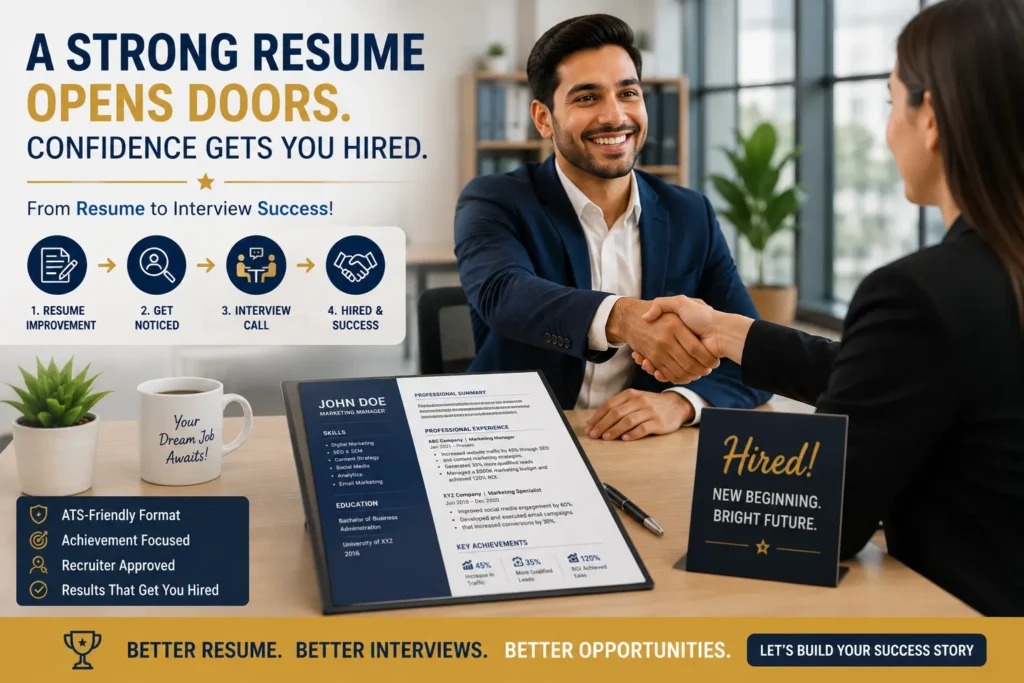
Your resume should open doors not close them.
If you’re applying for jobs but not receiving interview invitations, it may be time to take a fresh look at how your experience is presented.
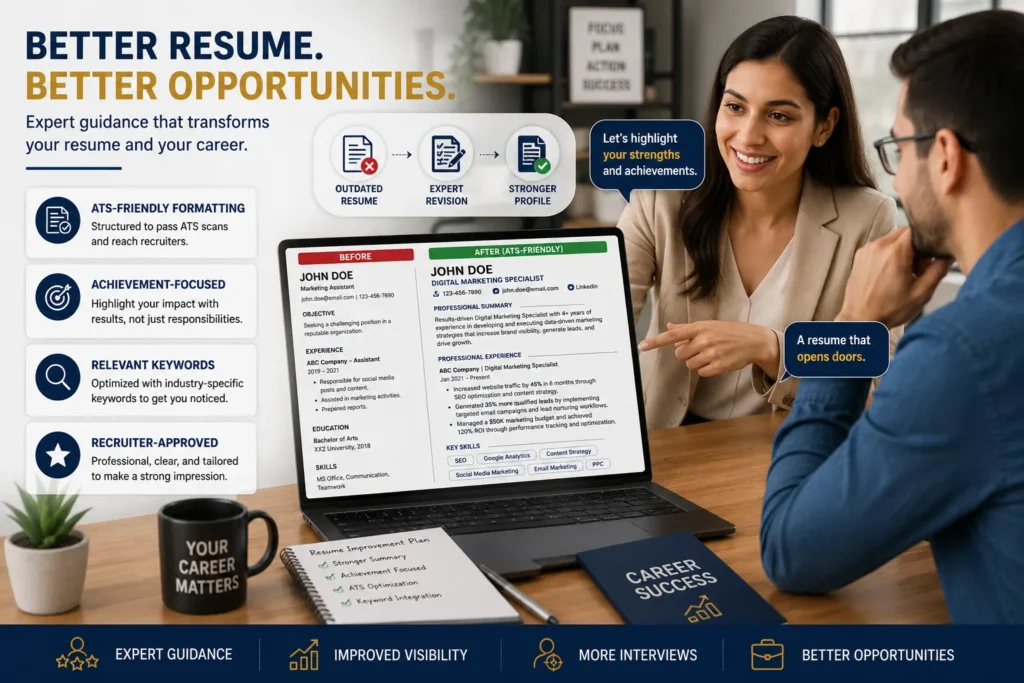
At JobApplyExpert, we help job seekers create professional, ATS-friendly resumes that clearly communicate their skills, achievements, and career potential. Our resume specialists understand what recruiters look for and create resumes that are tailored to today’s hiring standards.
Whether you’re a recent graduate, an experienced professional, or planning a career change, we’re here to help you build a resume that gives you greater confidence in your job search.
Explore our Professional Resume Writing Services and take the next step towards securing more interview opportunities.
Related Blogs You May Find Helpful
Improving your resume is just one step toward landing your ideal job. If you want to build a stronger job application and make informed career decisions, explore these related resources:
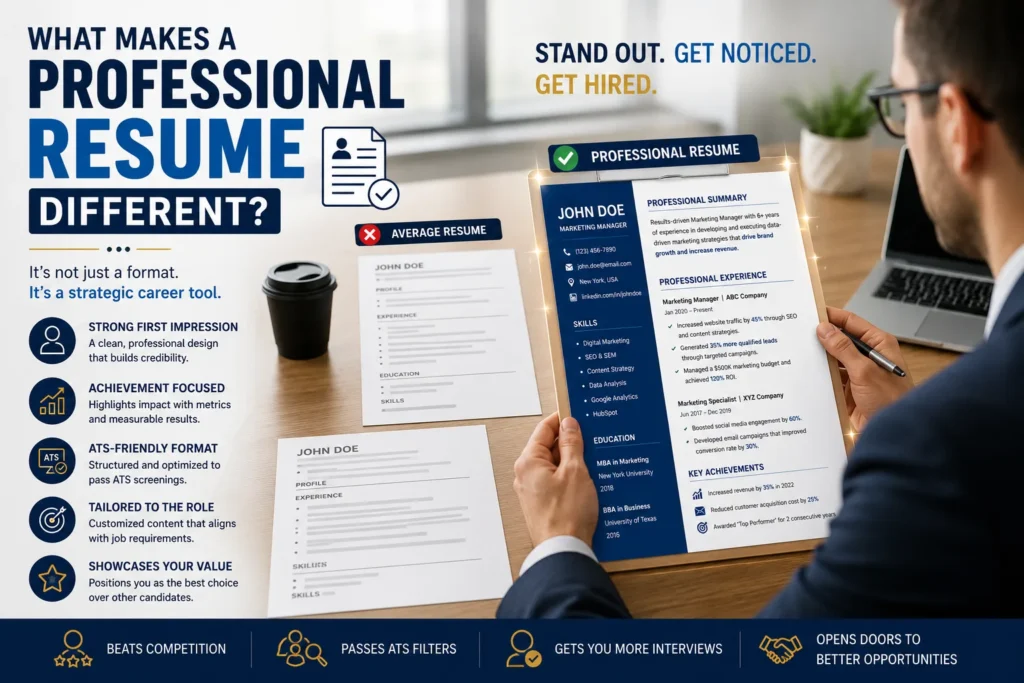
- What Makes a Professional Resume Different?
Learn what separates a professionally written resume from a standard one, including ATS-friendly formatting, achievement-focused content, keyword optimization, and recruiter-approved structure. - Resume vs CV: Understanding the Difference
Not sure whether you need a resume or a CV? This guide explains the key differences, when to use each document, and how to choose the right format for your career goals. - Career Counseling: How Professional Career Guidance Helps You Make Better Career Decisions
Discover how expert career counseling can help you identify the right career path, improve your job search strategy, prepare for interviews, and increase your chances of long-term career success.
Explore these articles to strengthen your resume, improve your job search strategy, and increase your chances of getting more interview calls.

 Sep 09, 2026

