


Quality vs. Quantity: Which Job Search Strategy Gets Better Results?
 Aug 07,2026
Table of Contents
If you’ve applied to dozens of jobs and heard nothing back, you’ve probably asked yourself the same question every job seeker eventually asks: is it better to apply everywhere, or apply carefully to a select few? The short answer is that neither extreme wins on its own. The most effective job search strategy blends the reach of quantity with the precision of quality, and knowing how to combine them is what separates a frustrating search from a fast one.
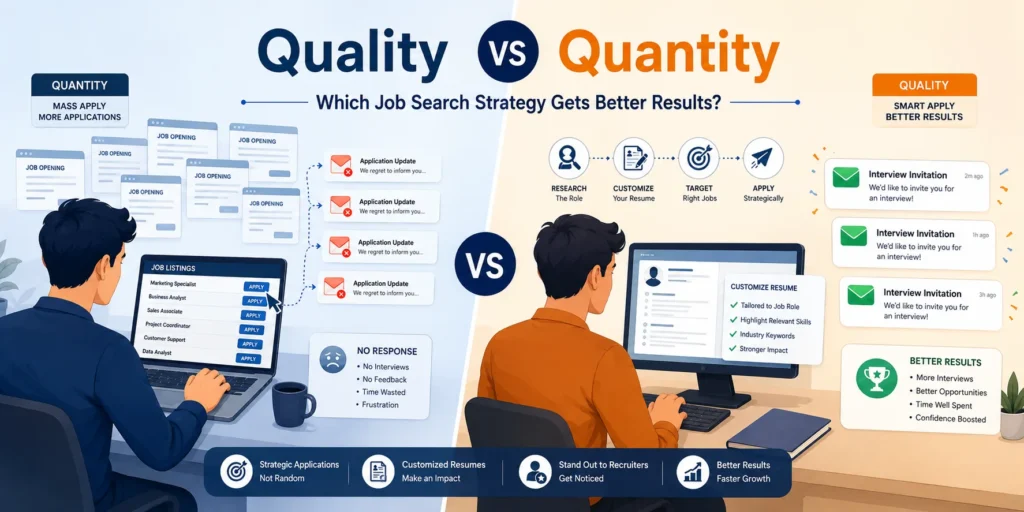
Let’s break down what each approach actually delivers, where it falls short, and how to build a job search strategy that works with today’s hiring market instead of against it.
The Case for Quantity: Cast a Wide Net
Applying broadly has an obvious appeal: more applications should mean more chances. And there’s some truth to that. In a market where the average job posting can attract 200 to 250 or more applicants, volume feels like the only way to beat the odds.
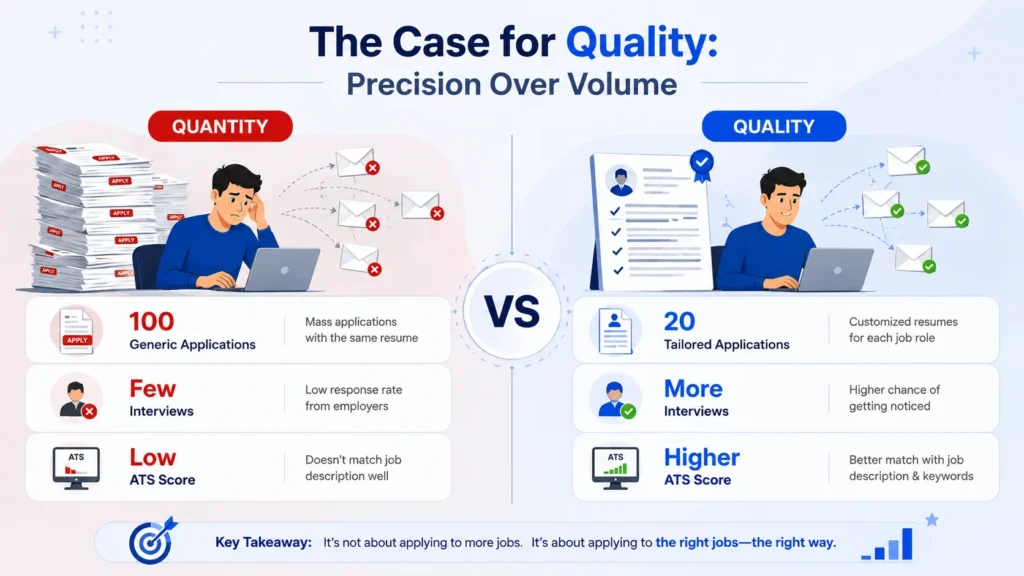
But the numbers tell a more complicated story. Generic, untailored applications typically convert to interviews at a rate of only 2 to 3 percent, and research from the Bureau of Labor Statistics has found that response rates actually start to decline once a job seeker passes roughly 80 applications submitted without added strategy or refinement. In other words, mass-applying doesn’t just plateau, it can backfire, burning time and motivation on submissions that were never likely to land.
Advantages of a quantity-focused approach:
- Wider exposure to opportunities, including roles you might not have considered
- Faster feedback loop on how your baseline resume performs
- Useful early in a search, when you’re still calibrating what “good fit” looks like
Disadvantages:
- Low conversion rates on generic applications
- Applicant tracking systems (ATS) filter out resumes that don’t closely match the job description
- Diminishing returns; a University of St. Louis Fed analysis of decades of labor data found that as application volume per job
seeker rose, overall placement rates stayed essentially flat - Emotional toll of high rejection volume with little personalized feedback
The Case for Quality: Precision Over Volume
A quality-focused job search strategy flips the equation. Instead of applying to everything remotely relevant, you research a shorter list of target companies, tailor your resume and cover letter to each role, and often reach out directly to someone at the company before or after applying.
The payoff shows up clearly in the data. Tailored applications have been shown to earn callback rates several times higher than generic ones, and referred candidates convert to interviews at roughly 50 percent, compared with single digits for cold applications. That gap exists because tailored materials pass ATS keyword matching more reliably, and because a referral signals to a hiring manager that someone they trust has already vouched for you.
Advantages of a quality-focused approach:
- Significantly higher response and interview rates per application
- Stronger alignment with roles you’re actually suited for, which also improves long-term job satisfaction
- Better use of limited time, especially for experienced professionals with fewer hours to spare
Disadvantages:
- Slower to generate volume, which can feel discouraging in the short term
- Requires more upfront research per application
- Risk of over-focusing on a narrow list of “dream” employers who may not be hiring

Why Networking Changes the Equation
No conversation about job search strategy is complete without networking, because it quietly outperforms both pure quantity and pure quality-through-applications alone. Estimates vary by source and methodology, but multiple labor market studies consistently place the share of jobs filled through personal and professional connections somewhere in the 70 to 85 percent range, with a large portion of open roles never formally advertised at all. Referred candidates are also hired noticeably faster than those who apply cold.
This doesn’t mean applications don’t matter. It means networking should sit alongside your applications, not compete with them. A short message to a former colleague or a warm introduction from a LinkedIn connection can turn a cold application into a warm one overnight.
Building a Smarter Job Search Strategy: Best Practices
Tailor your resume for every role. Mirror the language in the job description, lead with your most relevant achievements, and quantify results wherever possible. This single habit is one of the biggest levers for improving your response rate.
Treat networking as a weekly task, not a last resort. Block time to message contacts, attend one relevant event or webinar a month, and re-engage your existing network before assuming you need new connections.
Manage your time like a budget. Rather than splitting hours evenly, allocate more time to roles that closely match your background and less to long-shot applications. A rough 70/30 split, favoring quality applications and networking over volume, works well for most job seekers.
Track your results and adjust. Keep a simple spreadsheet logging the company, role, application date, source (referral, job board, direct), and outcome. After 30 to 50 applications, patterns emerge that tell you exactly where to invest more effort, whether that’s a specific job board, a certain type of role, or a particular version of your resume.
The Verdict: A Hybrid Job Search Strategy Wins
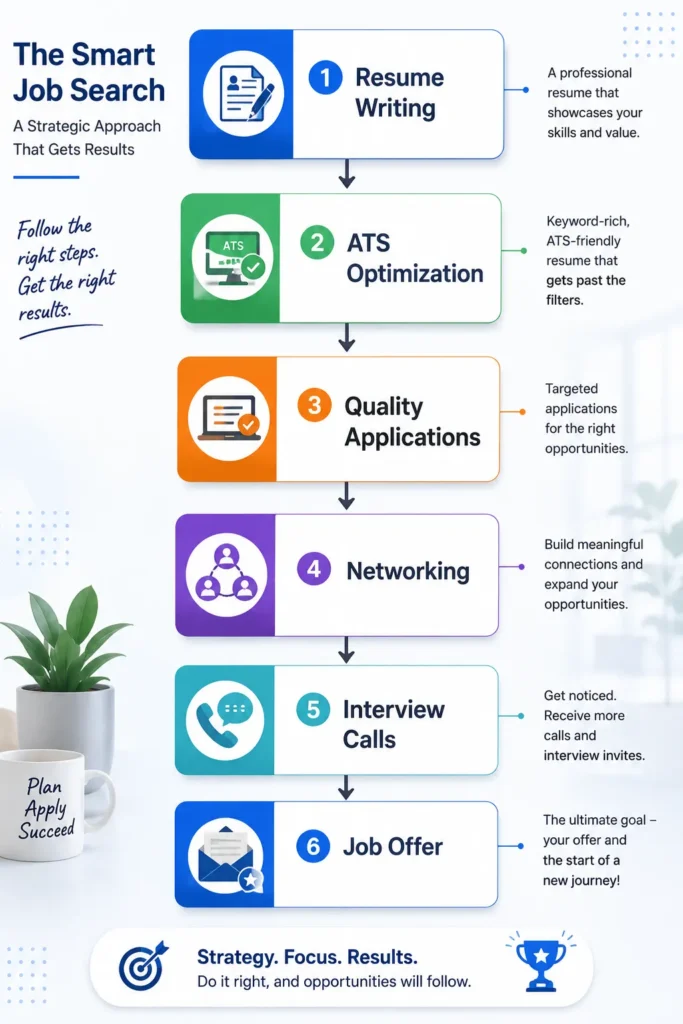
The evidence doesn’t favor one extreme. Pure volume wastes effort on applications unlikely to convert, while pure quality can be too slow if you only chase a handful of dream roles. The most effective job search strategy borrows from both: a focused shortlist of well-tailored applications, backed by consistent networking, and only a modest amount of broader applying to stay aware of the wider market.
If you’re early in your search, start broad enough to learn what resonates, then narrow quickly. If you’re deep into a search with little traction, that’s usually a sign to slow down, tailor more carefully, and lean harder into your network. Track everything, adjust often, and remember that the goal was never to apply the most, but to apply the smartest.
Related Blogs
- Job Application Tips: How to Apply for Jobs Faster Without Applying Randomly
- Job Search Assistance: How Professional Job Application Services Can Simplify Your Job Search
- How IT Resume Writing Can Help Tech Professionals Stand Out
- Tech Resume: How to Tailor Your Resume for the Tech Job Market
- Tech Hiring Trends in 2026: Why Tech Companies Are Hiring More Selectively
Which is better: quality or quantity in a job search?
A balanced job search strategy often delivers the best results. Applying to roles that closely match your skills with tailored application materials is generally more effective than submitting a large number of generic applications. Combining quality applications with consistent networking can improve your chances of securing interviews.
Why do quality job applications get better results?
Quality job applications are tailored to the specific role and highlight relevant skills, achievements, and experience. They are more likely to pass Applicant Tracking Systems (ATS) and attract recruiter attention than generic applications submitted in high volumes.
Is it better to apply for many jobs or focus on a few?
Focusing on relevant opportunities and submitting well-prepared applications often leads to better interview outcomes than applying to every available position. A targeted approach helps ensure your resume matches the employer’s requirements and improves your overall success rate.
How many job applications should I submit each week?
There is no ideal number of job applications that guarantees success. Instead of focusing only on quantity, prioritize applying for positions that match your qualifications and customize your application for each role.
Can networking improve my job search strategy?
Yes. Networking can help you discover opportunities, receive referrals, and connect directly with hiring managers or recruiters. Combining networking with high-quality job applications creates a more effective job search strategy than relying on online applications alone.
Why is tailoring a resume important when applying for jobs?
Tailoring your resume helps demonstrate that your skills and experience match the requirements of the role. It also improves ATS compatibility and makes it easier for recruiters to identify you as a strong candidate.
What is the biggest mistake job seekers make during a job search?
One of the most common mistakes is focusing only on the number of applications submitted rather than the quality of each application. Sending generic resumes to multiple employers often results in fewer interview opportunities than applying strategically with customized application materials.
How can I improve my job search results?
Improve your job search by targeting roles that match your experience, customizing your resume for each application, building your professional network, preparing for interviews, and tracking your applications to identify what works best.

 Sep 09, 2026

