


Tech Hiring Trends in 2026: Why Tech Companies Are Hiring More Selectively
 Aug 31,2026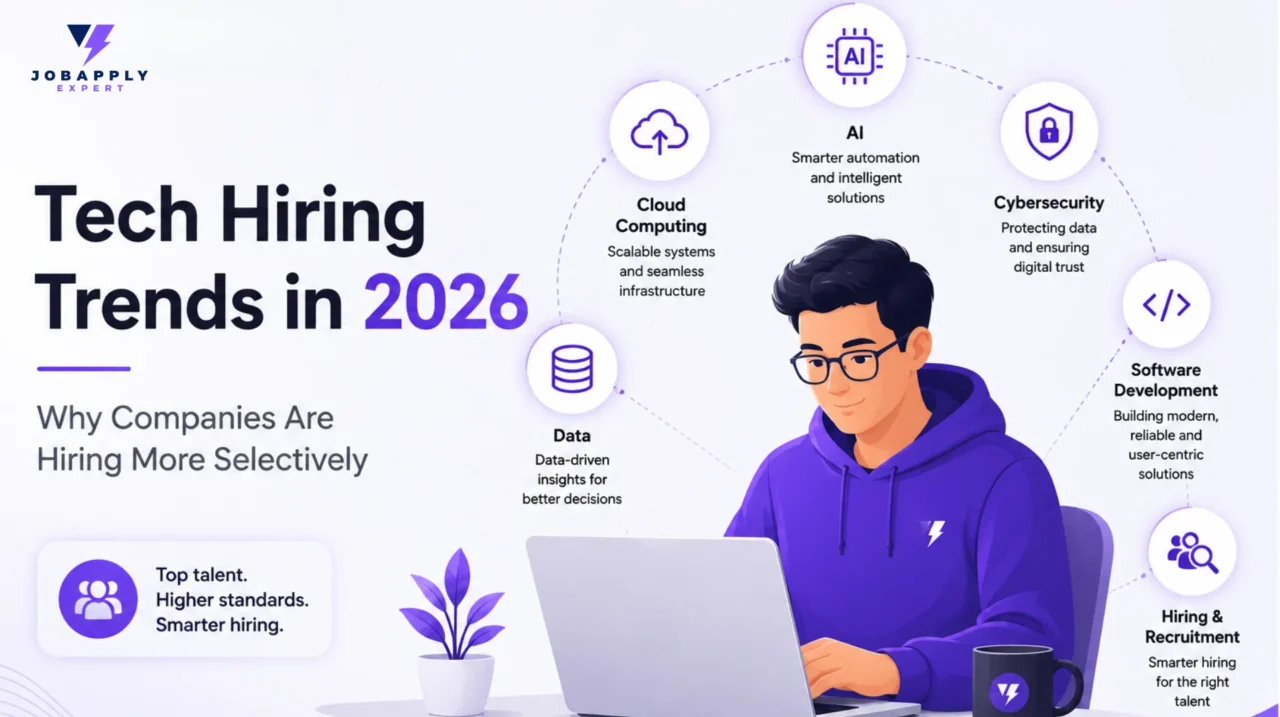
Tech Hiring Trends in 2026 point to an important shift: technology companies are still investing in software, artificial intelligence, cybersecurity, cloud infrastructure, and data, but many employers are becoming more selective about who they hire, which skills they prioritize, and how new roles contribute to business goals.
This does not mean the tech job market has stopped creating opportunities. U.S. Bureau of Labor Statistics projections show that computer and information technology occupations are expected to grow faster than average through 2034, with about 317,700 openings per year on average under the 2024–34 projections. At the same time, recent reporting suggests that the recovery in software hiring has been stronger for experienced candidates than for entry-level workers.
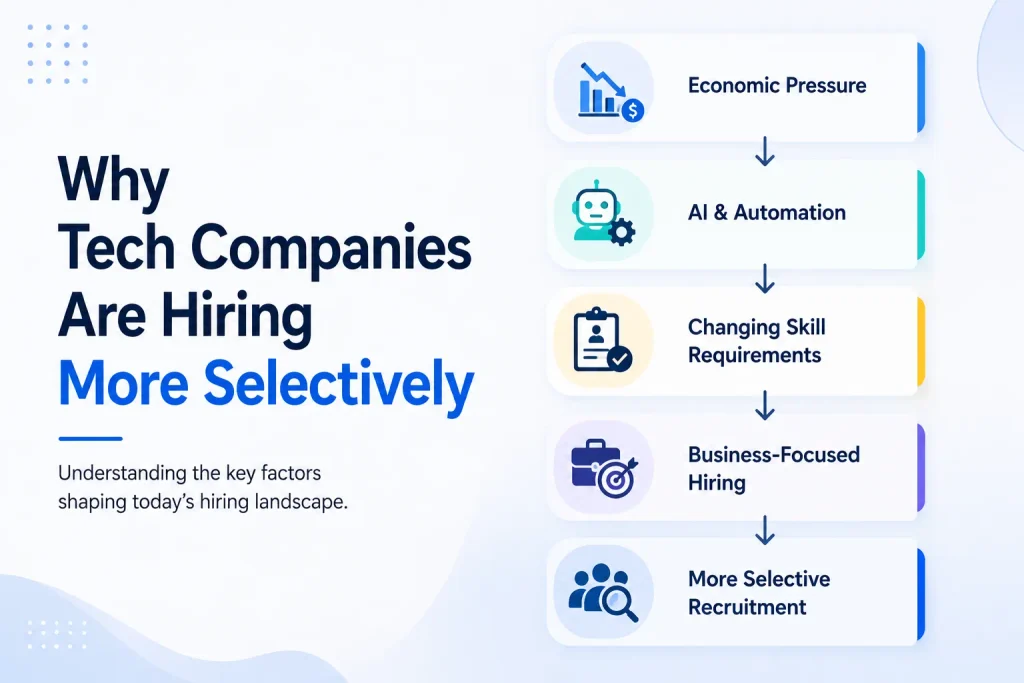
So, why are companies becoming more selective? The answer involves several forces working together: tighter cost control, changing technology requirements, AI adoption, higher expectations for productivity, and a stronger focus on hiring people who can create measurable value.
What Are the Biggest Tech Hiring Trends in 2026?
The biggest change is that companies are increasingly looking beyond how many people they can hire and focusing on which capabilities they actually need.
Technology remains an important source of employment growth. BLS projects software developer employment to increase by 15.8% between 2024 and 2034, while information security analysts are projected to grow by 29%. The information sector is also projected to be one of the faster-growing parts of the U.S. economy, driven in part by demand for software, cloud computing, cybersecurity, and AI-based systems.
The result is a more targeted hiring environment. Companies may have fewer openings than during previous hiring booms, but they can still compete aggressively for candidates with skills that directly support their priorities.
Why Are Tech Companies Hiring More Selectively?
1. Companies Are Focusing More Closely on Business Value
During periods of rapid expansion, companies can afford to hire ahead of demand. In a more cautious environment, employers tend to examine whether each position is necessary and what the employee is expected to accomplish.
That means a candidate may need to demonstrate more than technical knowledge. Hiring managers increasingly want to understand how someone can improve efficiency, reduce costs, build products, strengthen security, increase revenue, or solve difficult technical problems.
For job seekers, this makes results-focused experience more valuable than a simple list of responsibilities.
Instead of saying:
“Managed cloud infrastructure.”
A stronger resume statement might explain the outcome:
“Automated cloud deployment workflows to reduce release time and improve production reliability.”
The second version gives an employer a clearer reason to consider the candidate.
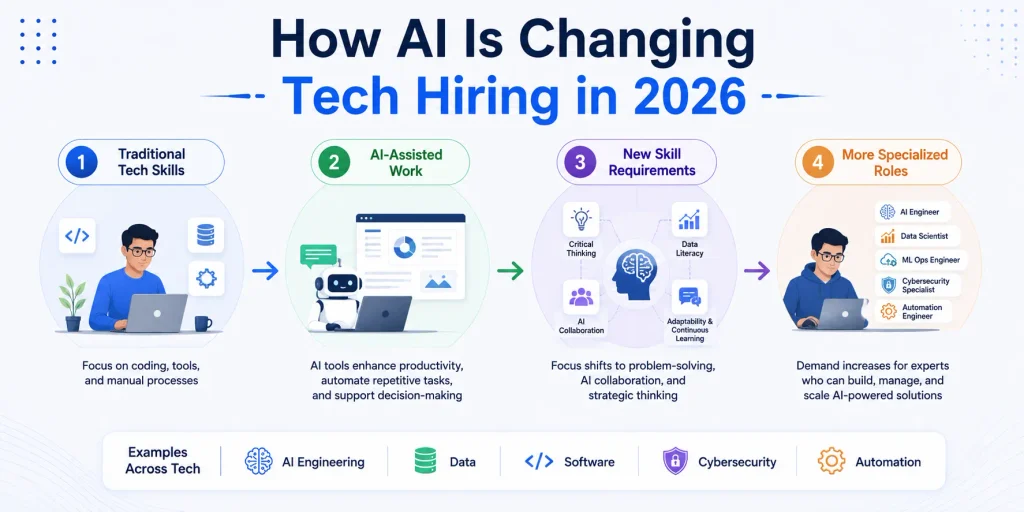
2. AI Is Changing Which Skills Companies Need
Artificial intelligence is one of the biggest forces behind current Tech Hiring Trends.
The World Economic Forum reports that 69% of surveyed employers plan to recruit talent skilled in AI tool design and enhancement, while 62% expect to focus on hiring people who can work effectively with AI. At the same time, 41% of employers expect to reduce some workforce requirements as AI automates particular tasks.
This creates a complicated situation for technology professionals.
AI is not simply replacing technology workers. In many cases, it is changing the tasks those workers perform.
A software developer may now be expected to use AI-assisted development tools. A data professional may use AI for analysis. A cybersecurity team may use AI to identify threats. An IT professional may automate routine support tasks.
Consequently, employers increasingly value candidates who can use AI effectively while applying human judgment to complex problems.
3. Skills Requirements Are Becoming More Specialized
Technology employers are increasingly looking for specific combinations of skills rather than broad technology familiarity.
For example, a company hiring a cloud engineer might prioritize:
- AWS or Azure
- Infrastructure as code
- Kubernetes
- CI/CD
- Cloud security
- Automation
A cybersecurity employer may instead prioritize:
- Threat detection
- Security operations
- Cloud security
- Incident response
- Risk management
This specialization means that having a long list of technologies on a resume isn’t necessarily an advantage.
The better approach is to demonstrate depth and relevance.
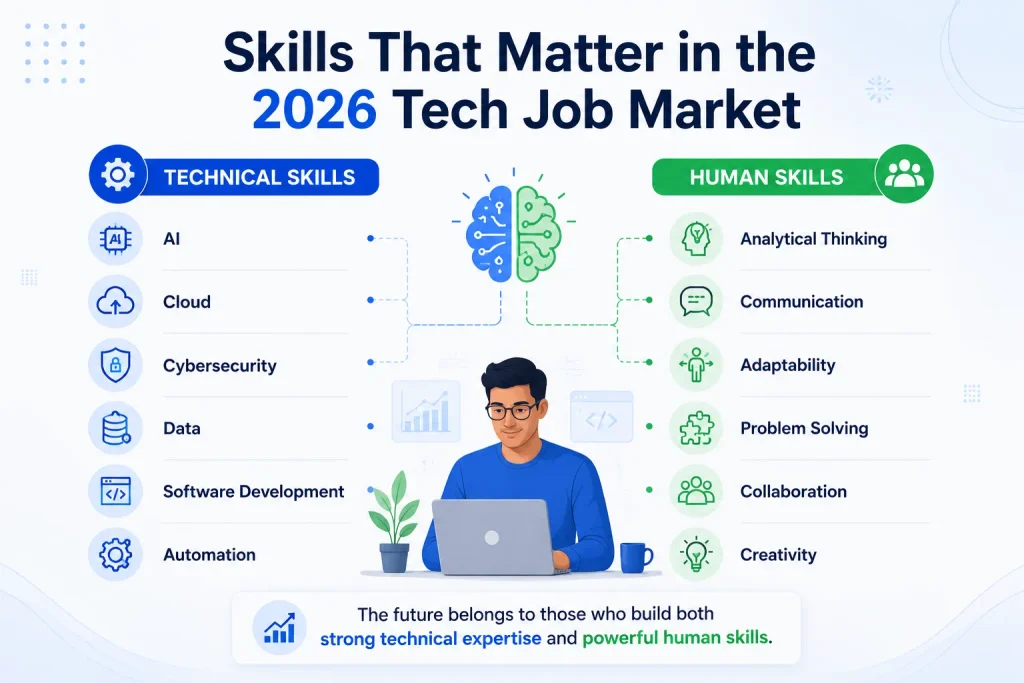
The World Economic Forum identifies AI and big data, networks and cybersecurity, and technological literacy among the fastest-growing skill areas, while also emphasizing human capabilities such as analytical thinking, resilience, flexibility, and collaboration.
Why Entry-Level Tech Hiring Is Particularly Challenging
One of the more difficult aspects of current Tech Hiring Trends is the pressure on entry-level candidates.
Recent reporting based on Indeed data found that nearly 70% of U.S. software development job postings in early 2026 were targeting senior engineers, compared with 55% in 2019. One explanation is that AI tools can handle some routine development tasks, increasing the value employers place on experienced professionals who can make complex technical decisions and evaluate AI-generated work.
This does not mean there are no opportunities for junior professionals. It does mean that candidates entering technology careers may need to demonstrate practical ability earlier.
Projects, internships, open-source contributions, technical portfolios, certifications, and clearly documented problem-solving experience can help bridge the gap between education and professional experience.
Companies Are Hiring for Adaptability, Not Just Technical Skills
Technical expertise remains essential, but technology changes too quickly for companies to rely only on today’s tools.
The World Economic Forum estimates that nearly 40% of skills required on the job are expected to change by 2030, with 63% of employers identifying skills gaps as a major barrier to business transformation.
That helps explain why employers increasingly value people who can learn.
A candidate who knows one specific tool extremely well may be useful today. A candidate who understands the underlying concepts, can learn new tools quickly, communicates effectively, and adapts to changing technology may offer greater long-term value.
For job seekers, this means highlighting both technical skills and transferable capabilities.
What These Tech Hiring Trends Mean for Job Seekers
A more selective hiring market requires a more focused job search.
Tailor Your Resume to the Role
Don’t send exactly the same resume to every employer. Identify the skills and responsibilities emphasized in the job description and highlight the experience that genuinely matches them.
A professionally structured resume can also help you present your most relevant technical experience clearly. Explore Professional Resume Writing Services to learn how a resume can be positioned around specific career goals.
If you’re targeting technology positions, our guide on How to Write a Professional IT Resume explains how to present technical skills, projects, certifications, and achievements effectively.
Because many employers use applicant tracking technology to manage applications, understanding what makes an ATS-friendly resume can also help you present your qualifications more effectively.
Focus on Achievements
Recruiters need to understand what you accomplished, not simply what your job title required. Whenever possible, quantify improvements in revenue, efficiency, performance, security, cost, users, or delivery time.
Build Practical Evidence
If you’re targeting AI, cloud, cybersecurity, data, or software roles, create projects that demonstrate your ability to apply those technologies.
Develop AI Literacy
You don’t necessarily need to become an AI engineer. But understanding how AI tools affect your field can make you more competitive and help you work effectively alongside them.
Strengthen Your Human Skills
Analytical thinking, communication, collaboration, creativity, and adaptability remain important even as technical tools evolve.
How JobApplyExpert Can Help Candidates Navigate Selective Hiring
When employers are more selective, how you present your experience can matter just as much as the experience itself.
JobApplyExpert helps job seekers approach the application process with a more targeted strategy through professional resume writing, resume customization, job application support, and career consulting.
For technology professionals, this can mean positioning relevant skills and achievements more clearly for the specific role being targeted. A software developer applying for an AI-focused position, for example, may need to emphasize Python, machine learning projects, APIs, cloud technologies, and AI-related experience rather than presenting every technology they have encountered.
Similarly, a cybersecurity candidate may need to prioritize security tools, certifications, incident response experience, and measurable security outcomes.
The objective isn’t to add keywords that don’t reflect your background. It’s to make genuine qualifications easier for recruiters and hiring teams to identify.
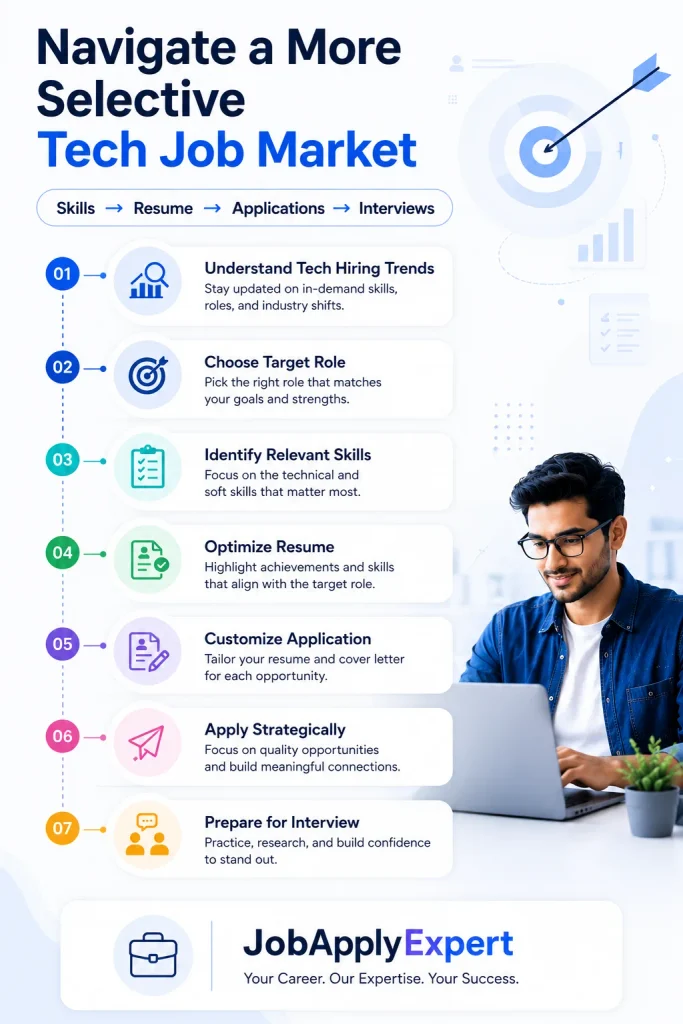
As Tech Hiring Trends continue to favor targeted skills and demonstrable results, a focused resume and organized application strategy can help candidates compete more effectively.
Once your resume and target roles are defined, Job Application Services can help make the application process more focused and organized.
Learn more about how we customize every resume before applying and why role-specific positioning matters in a competitive hiring environment.
Candidates who are unsure which technology career path best fits their skills can also explore Career Consultant Services for broader career planning and guidance.
What Employers Can Learn From the Shift
Selective hiring is not only a challenge for candidates. Employers also need to be careful about becoming too restrictive.
If companies demand extensive experience for every position, they may reduce opportunities for junior professionals and weaken their future talent pipeline. Recent analysis of software hiring has raised similar concerns about fewer entry-level opportunities and the long-term challenge of developing experienced engineers.
A balanced strategy can combine experienced hires with apprenticeships, internal training, mentorship, and opportunities for emerging talent.
The World Economic Forum’s research also shows that employers are increasingly responding to skills gaps through upskilling and broader talent strategies.
How to Adapt to Tech Hiring Trends in 2026
The selective hiring environment doesn’t mean job seekers should apply to fewer jobs blindly. It means they should apply more strategically.
This is why one resume is not enough for every job application, particularly when different technology roles require different skills and experience.
Before applying, ask:
- Does my experience match the core requirements?
- Can I demonstrate the skills the employer actually needs?
- Does my resume show measurable results?
- Have I tailored my application to this position?
- Can I explain how I use current technologies, including AI, in practical situations?
- Can I demonstrate both technical and communication skills?
If the answer is yes, the application is likely to be stronger than simply submitting a high volume of generic resumes.
Final Takeaway
The most important Tech Hiring Trends in 2026 point toward a more deliberate and skills-focused hiring environment. Technology companies continue to need software developers, cybersecurity professionals, cloud specialists, data experts, and AI talent, but employers are increasingly looking for candidates who can demonstrate immediate relevance and measurable value.
For job seekers, the response should not be panic or mass applications. Build relevant skills, understand how AI is changing your field, demonstrate practical achievements, and customize your resume for the roles you genuinely want.
The candidates who stand out in 2026 may not be those who know the most technologies. They are likely to be the professionals who can combine relevant technical expertise with adaptability, problem-solving, and clear evidence of the value they can deliver.
Frequently Asked Questions About Tech Hiring Trends in 2026
1. Why are tech companies hiring more selectively in 2026?
Tech companies are becoming more selective because they are focusing more closely on costs, productivity, business value, and specific skill requirements. AI adoption and changing technology needs are also influencing which roles companies prioritize and what skills they expect candidates to have.
2. Is the tech job market still growing in 2026?
Yes. Many technology occupations continue to have positive long-term employment outlooks, particularly in areas such as software development, cybersecurity, data, cloud computing, and artificial intelligence. However, hiring conditions vary by role, industry, location, and experience level.
3. What skills are tech companies looking for in 2026?
Employers are increasingly looking for a combination of technical and human skills. Depending on the role, these can include artificial intelligence, cloud computing, cybersecurity, data analytics, software development, automation, problem-solving, analytical thinking, communication, and adaptability.
4. How is AI affecting tech hiring in 2026?
AI is changing both the skills employers need and how technology professionals work. Companies are hiring people who can use AI tools effectively while also applying technical knowledge, critical thinking, and human judgment. Some routine tasks may become automated, while new opportunities are emerging around AI development, integration, data, and infrastructure.
5. Why are entry-level tech jobs harder to find in 2026?
Some companies are prioritizing experienced candidates who can contribute quickly to specialized projects, particularly as AI tools automate certain routine tasks. This can make entry-level hiring more competitive. Candidates can improve their position by developing practical projects, internships, certifications, portfolios, and demonstrable technical skills.

 Sep 09, 2026

