Tech Job Market in 2026: What Job Seekers Need to Know
Aug 21,2026
Tech job market conditions in 2026 are being shaped by a combination of artificial intelligence, cybersecurity needs, cloud adoption, data growth, automation, and changing employer expectations. For job seekers, this means technology careers continue to offer opportunities, but the skills employers value are changing quickly.
The outlook is not simply about having a technology degree or knowing one programming language. Employers increasingly want professionals who can combine technical expertise with problem-solving, adaptability, communication, and an ability to work effectively with new technologies.
For anyone planning a technology career, understanding these tech job market trends can help identify where demand is moving and which skills are worth developing.
What Is Happening in the Tech Job Market in 2026?
The overall outlook for technology occupations remains positive, although hiring conditions vary significantly by role and industry.
In the United States, the Bureau of Labor Statistics projects computer and information technology occupations to grow much faster than the average for all occupations from 2024 to 2034, with approximately 317,700 openings per year on average from employment growth and replacement needs.
That does not mean every technology role will grow at the same pace. Some traditional roles are changing because of automation, while demand is increasing for professionals working with AI, data, cybersecurity, cloud infrastructure, and software.
Globally, the World Economic Forum also identifies technology-related positions among the fastest-growing occupations through 2030, including Big Data Specialists, FinTech Engineers, AI and Machine Learning Specialists, and Software and Application Developers.
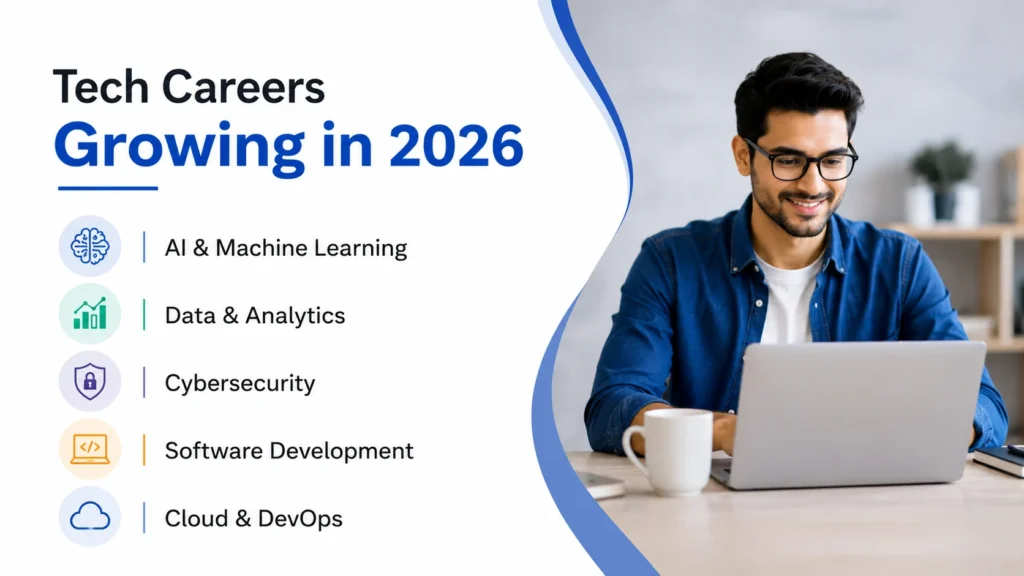
Which Technology Jobs Are Growing?
One of the biggest developments in the tech job market is the increasing demand for professionals who can build, manage, secure, and apply emerging technologies.
Artificial Intelligence and Machine Learning
AI continues to influence software development, business operations, customer service, research, and many other areas.
This is creating opportunities for professionals working in:
AI engineering
Machine learning
Generative AI
AI infrastructure
Data science
AI product development
The World Economic Forum lists AI and Machine Learning Specialists among the fastest-growing job categories globally.
Data and Analytics
Organizations are generating more data and looking for professionals who can turn that information into useful decisions.
Data scientists, data engineers, analytics professionals, and database specialists can benefit from this trend. In the United States, BLS projects 34% growth for data scientists from 2024 to 2034, significantly faster than average employment growth.
Cybersecurity
As organizations expand their digital infrastructure, protecting systems and data becomes increasingly important.
Cybersecurity careers include:
Information security analyst
Security engineer
Security operations specialist
Cloud security professional
Risk and compliance specialist
BLS projects information security analyst employment to grow 29% from 2024 to 2034, with about 16,000 openings per year on average.
Software Development
Software development remains an important part of the technology workforce even as AI changes how developers work.
BLS projects employment for software developers, quality assurance analysts, and testers to grow 15% from 2024 to 2034, with approximately 129,200 openings per year on average.
The nature of development work is changing, however. Developers increasingly need to understand cloud platforms, automation, AI-assisted development, APIs, security, and modern software architecture.
Which Skills Are Most Important in 2026?
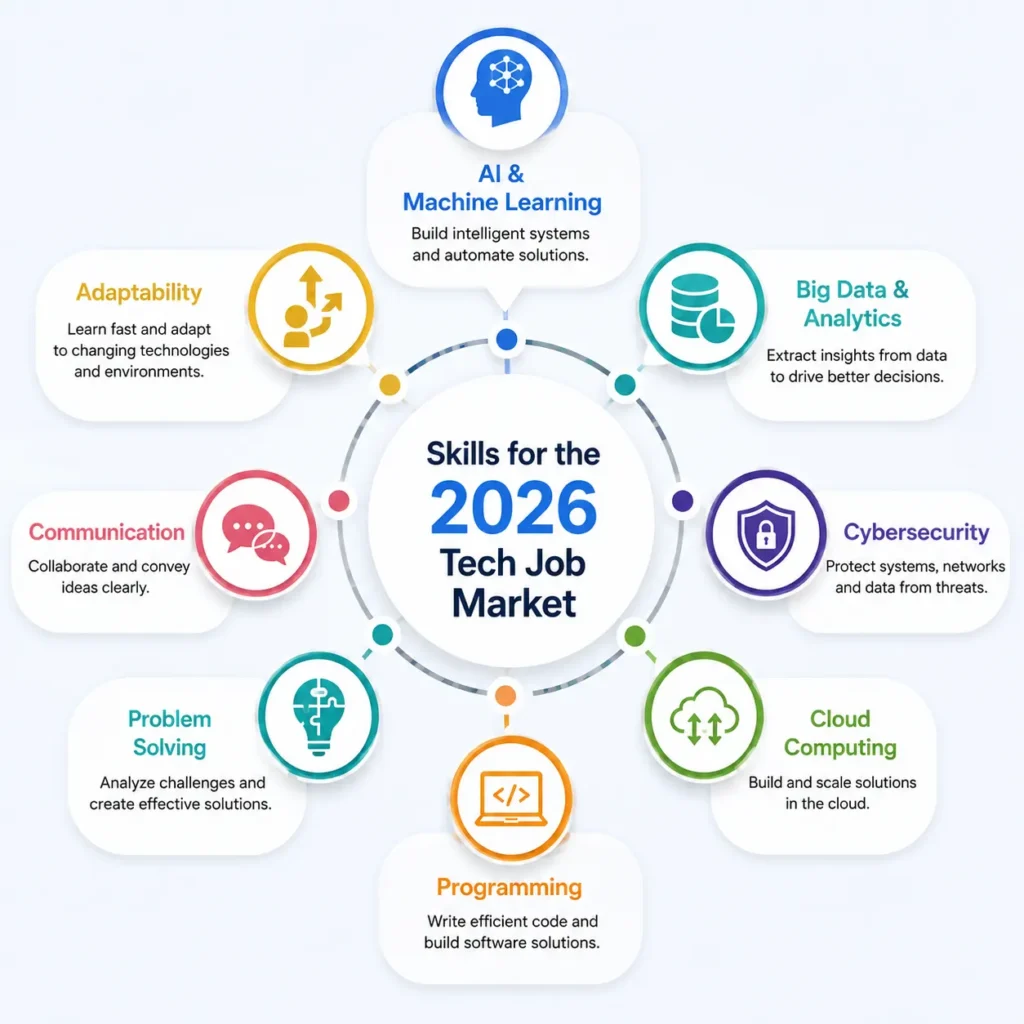
Technical skills remain essential, but the tech job market increasingly rewards professionals who combine technical and human capabilities.
The World Economic Forum identifies AI and big data as the fastest-growing skill area, followed by networks and cybersecurity and technological literacy. At the same time, creative thinking, resilience, flexibility, curiosity, and lifelong learning are also expected to increase in importance.
For job seekers, that suggests a useful skills combination:
Technical skills + business understanding + problem-solving + communication + continuous learning
For example, knowing Python is useful. Knowing Python and being able to explain how you used it to automate a process, reduce costs, improve data analysis, or solve a business problem is much more valuable.
How Is AI Changing Technology Jobs?
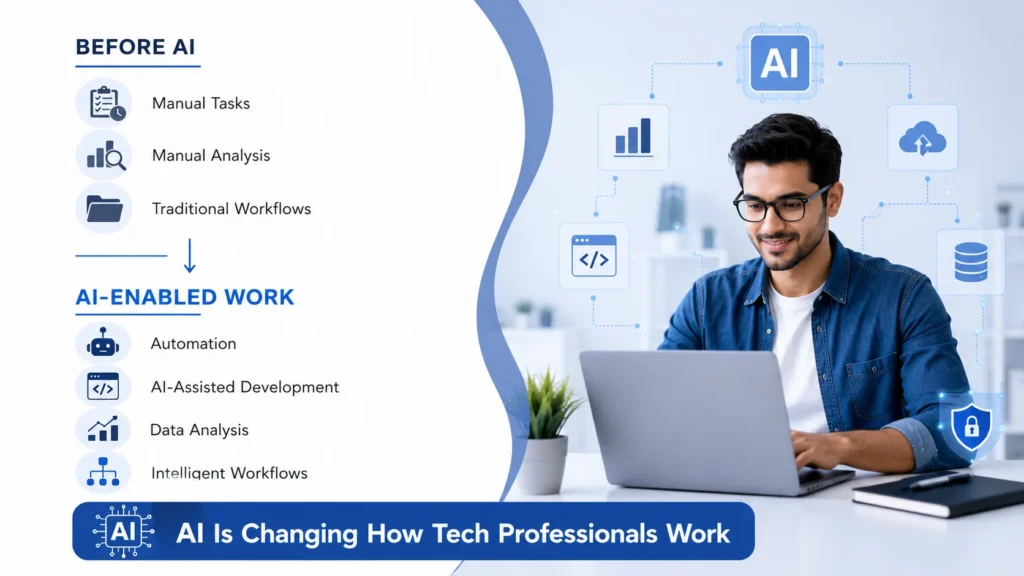
AI is both creating opportunities and changing existing jobs.
The World Economic Forum reports that 86% of surveyed employers expect AI and information-processing technologies to transform their businesses by 2030. It also reports that 77% of employers plan to upskill workers in response to AI, while 41% expect workforce reductions where AI automates certain tasks.
This highlights an important point: AI is not simply a story about jobs disappearing.
For many technology professionals, the bigger change is that the tasks within their jobs are evolving.
Developers may use AI coding tools. Data professionals may use AI for analysis and modeling. IT teams may automate routine support tasks. Security teams may use AI to identify threats faster.
The professionals who learn how to work with AI rather than ignore it may be better positioned as these changes continue.
As more employers use technology to manage applications, understanding what makes an ATS-friendly resume can help you present your qualifications more effectively.
Where Are Technology Opportunities Growing?
Technology employment is no longer limited to traditional technology companies.
Software, cloud, AI, cybersecurity, and data professionals are needed across industries such as:
Financial services
Healthcare
Manufacturing
Retail
Telecommunications
Professional services
Government
Automotive
Energy
In India, for example, the World Economic Forum identifies Big Data Specialists, AI and Machine Learning Specialists, and Security Management Specialists among projected fast-growing roles. Indian employers also expect strong transformation from AI, robotics, semiconductors, computing technologies, and other emerging technologies.
This means job seekers should look beyond companies labeled simply as “tech companies.” A bank hiring cloud engineers or a healthcare organization hiring cybersecurity professionals is also part of the broader technology employment market.
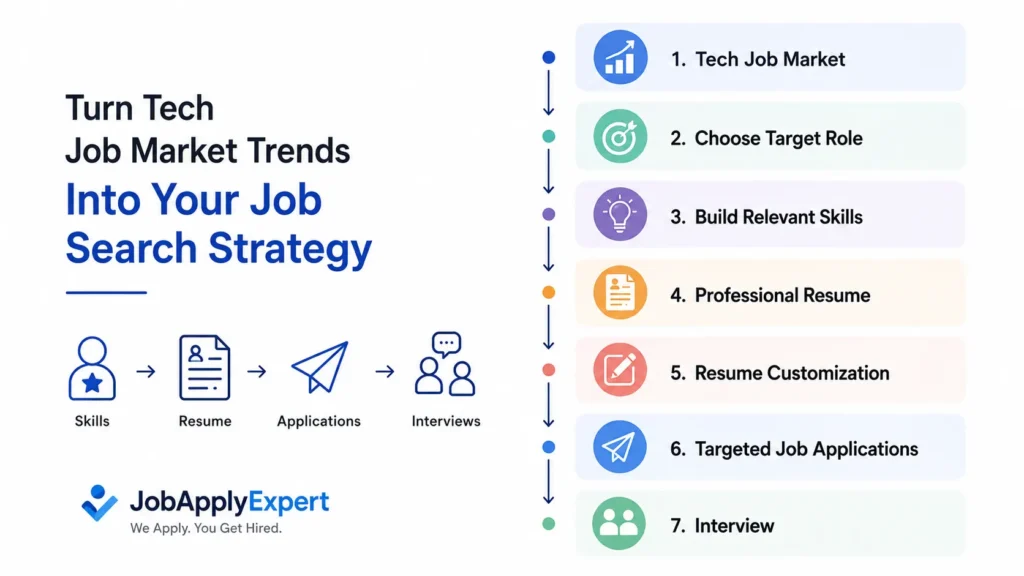
What Should Job Seekers Do in 2026?
The most effective response to changing tech job market trends is to become more intentional about your career strategy.
1. Choose a Clear Career Direction
Instead of trying to learn every new technology, identify a target area such as cloud engineering, cybersecurity, data engineering, software development, or AI.
2. Build Skills Around Real Projects
Employers need evidence that you can apply your knowledge. Build projects, contribute to relevant work, create a portfolio, or document measurable results from professional experience.
3. Keep Learning
The World Economic Forum estimates that around 39% of workers’ existing skill sets could be transformed or become outdated between 2025 and 2030. Continuous learning is therefore becoming a normal part of technology careers rather than something reserved for beginners.
4. Update Your Resume for Each Role
A generic resume may not show why you’re a good match for a specific technology position. Highlight the skills, technologies, projects, and achievements that are most relevant to the role.
If you’re targeting technology positions, see our guide on How to Write a Professional IT Resume for practical advice on presenting technical skills, projects, achievements, and certifications.
5. Develop Human Skills
Technical knowledge alone isn’t enough. Analytical thinking, communication, collaboration, adaptability, and creative problem-solving remain important alongside technology skills.
How JobApplyExpert Can Help Tech Job Seekers Navigate the 2026 Job Market
Understanding the tech job market is only the first step. Knowing where opportunities exist is useful, but job seekers also need to present their experience effectively and apply strategically.
This is where JobApplyExpert can support candidates throughout the job search process. The service focuses on resume optimization, targeted job applications, and career support, helping job seekers connect their experience with relevant opportunities.
JobApplyExpert’s Professional Resume Writing Services focus on role-specific resumes, ATS-friendly formatting, relevant keywords, and industry-specific positioning.
For technology professionals, this can be particularly useful when applying for roles where specific skills and technologies matter. JobApplyExpert’s resume writing service focuses on role-specific resumes, ATS-friendly formatting, relevant keywords, and industry-specific positioning. Its technology coverage includes roles such as software engineering, AI and machine learning, data science, cloud and DevOps, cybersecurity, QA, and business analysis.
The application process can also be time-consuming. JobApplyExpert says its human assistants review job descriptions, tailor resumes for individual roles, apply to relevant opportunities, and track applications.
For someone navigating a rapidly changing tech job market, this approach can help turn market research into a more organized job search. Instead of simply applying to as many positions as possible, candidates can focus on roles that match their skills, experience, career goals, and target market.
Once your resume and career direction are ready, Job Application Services can help streamline the process of identifying and applying to relevant opportunities.
For professionals who are unsure which technology specialization to pursue or how to position themselves for their next career move, Career Consultant Services can provide more personalized career guidance.
What This Means for Tech Professionals
If you’re searching for a technology role in 2026, consider focusing on three areas:
Build the right skills. Keep developing technical and human skills that are relevant to your target role.
Position your experience effectively. Make sure your resume clearly demonstrates how you’ve used technologies to solve problems and deliver results.
Apply strategically. Target roles that genuinely match your background instead of relying entirely on high-volume applications.
That combination can make your job search more focused as technology roles and employer expectations continue to evolve.
The Future of the Tech Job Market
The tech job market in 2026 is best understood as a market in transition rather than one that is simply growing or shrinking.
AI and automation are changing how work is performed, while cybersecurity, data, software, cloud infrastructure, and emerging technologies continue to create new opportunities. Some roles will decline or change significantly, while others will expand.
For job seekers, the most valuable strategy is not to chase every technology trend. Instead, build a strong foundation, specialize in an area with genuine demand, understand how AI affects your field, and continue developing both technical and human skills.
Final Takeaway
The tech job market remains full of opportunities in 2026, but employers are becoming more selective about the skills and value candidates can demonstrate.
AI, data, cybersecurity, software development, and cloud technologies are among the areas showing strong long-term potential. At the same time, adaptability, analytical thinking, communication, and continuous learning are becoming increasingly important.
The professionals most prepared for the future won’t necessarily be those who know the most technologies. They will be the ones who can apply the right technology to solve real problems and continue learning as the industry changes.
Frequently Asked Questions About the Tech Job Market in 2026
1. What is the tech job market like in 2026?
The tech job market in 2026 is evolving around artificial intelligence, cybersecurity, data, cloud computing, and software development. Employers are increasingly looking for candidates who combine technical skills with adaptability, problem-solving, and communication abilities.
2. Which tech jobs are in demand in 2026?
Some of the technology roles showing strong demand include AI and machine learning specialists, data professionals, cybersecurity professionals, software developers, cloud engineers, and DevOps professionals. Demand can vary by industry, location, experience level, and employer.
3. What skills are most important in the 2026 tech job market?
Important skills include AI and machine learning, data and analytics, cybersecurity, cloud computing, programming, technological literacy, problem-solving, communication, and adaptability. The right combination depends on the specific technology role.
4. How is AI affecting tech jobs in 2026?
AI is changing how many technology professionals perform their work. Developers, data professionals, IT teams, and cybersecurity specialists are increasingly using AI tools to automate tasks, analyze information, improve workflows, and support decision-making. At the same time, some tasks may become automated, making continuous skill development increasingly important.
5. Is software development still a good career in 2026?
Yes. Software development remains an important technology career, although the skills expected from developers are changing. Knowledge of cloud platforms, APIs, automation, cybersecurity, modern development practices, and AI-assisted development can help professionals remain competitive.
6. Is cybersecurity a growing career field in 2026?
Cybersecurity continues to be an important area because organizations need to protect applications, infrastructure, networks, and data from increasing security risks. Roles in security engineering, threat detection, cloud security, compliance, and security operations can offer opportunities for qualified professionals.
7. How can I prepare for changes in the tech job market?
Start by choosing a target career direction, developing relevant technical skills, gaining practical experience through projects or professional work, keeping your knowledge current, and strengthening transferable skills such as communication and analytical thinking.
8. Should I customize my resume for technology jobs?
Yes. A customized resume can make the skills, technologies, projects, certifications, and achievements most relevant to a particular position easier for recruiters to identify. Instead of using exactly the same resume for every application, adjust it to reflect the requirements of each target role.
9. How can JobApplyExpert help with a tech job search?
JobApplyExpert provides career support that can include professional resume writing, resume customization, targeted job application support, and career consulting. For technology professionals, this can help connect their skills and experience with relevant job opportunities and create a more organized job search strategy.
10. Will technology jobs continue to grow in the future?
Many technology-related occupations are expected to continue evolving as organizations adopt AI, cloud computing, cybersecurity solutions, data technologies, and automation. However, individual roles can change significantly, so continuous learning and adaptability are important for long-term career development.



 Aug 21,2026

 Sep 09, 2026

