

The Rise of AI Engineering Jobs: Skills and Career Opportunities
 Aug 24,2026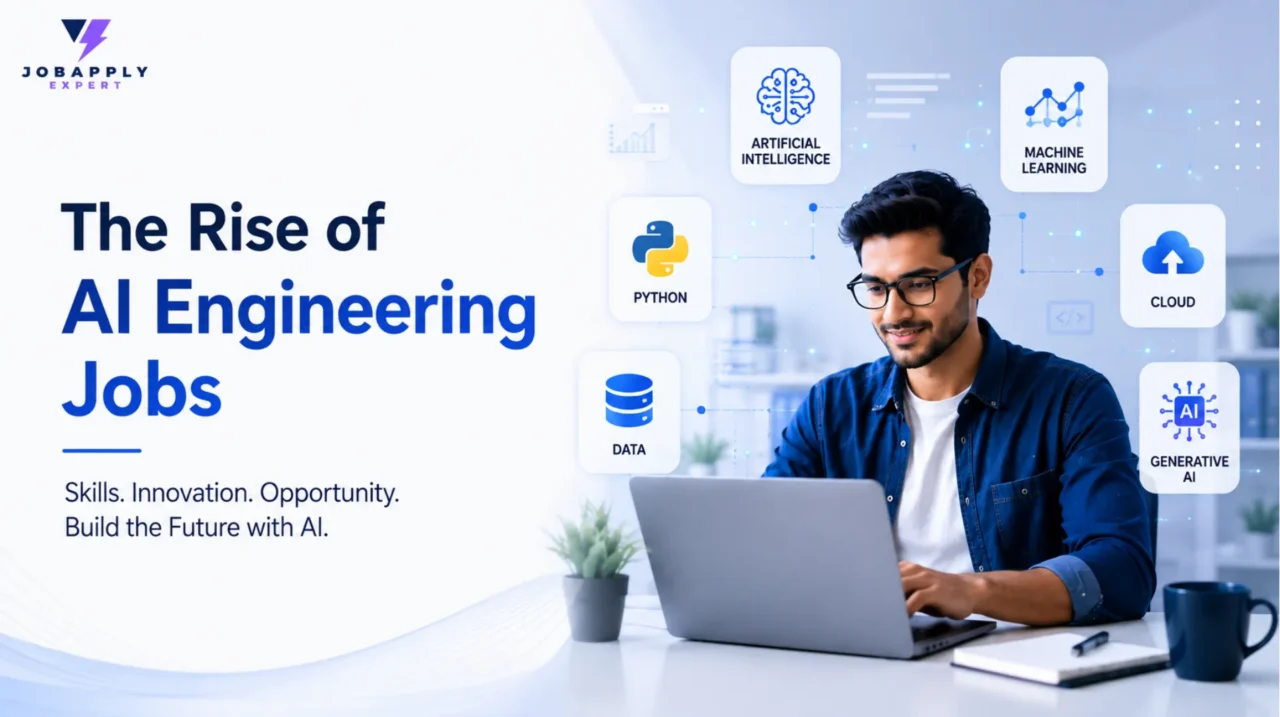
AI Engineering Jobs are becoming an increasingly important part of the modern technology workforce as organizations move from experimenting with artificial intelligence to building AI into everyday products, services, and business operations. From generative AI applications and machine learning systems to intelligent automation and AI-powered software, companies need professionals who can turn AI capabilities into reliable, useful solutions.
This growth is creating new opportunities for software developers, data professionals, machine learning specialists, and technology professionals who are willing to build the right combination of machine learning skills, software engineering knowledge, data expertise, and AI literacy.
The World Economic Forum lists AI and Machine Learning Specialists among the fastest-growing job categories through 2030, while AI and big data are identified as the fastest-growing skill area.
For job seekers considering artificial intelligence careers, understanding what AI engineering involves, which skills employers value, and where opportunities are developing can help create a more focused career strategy.
What Are AI Engineering Jobs?
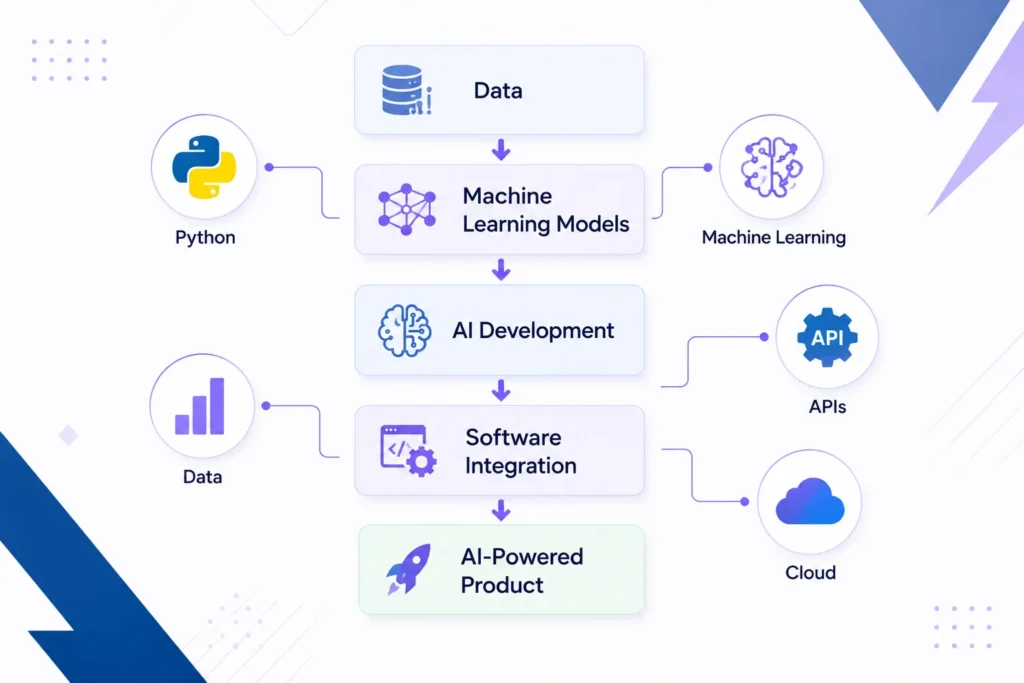
AI engineering jobs involve designing, developing, integrating, deploying, and maintaining systems that use artificial intelligence.
An AI engineer may work on machine learning models, generative AI applications, recommendation systems, computer vision, natural language processing, AI-powered automation, or systems that integrate large language models into existing software.
The role often sits between software engineering, machine learning, data science, and product development.
For example, a software developer may build an application, while an AI engineer might design the AI functionality that allows that application to understand text, generate responses, make predictions, or automate decisions.
Because of this overlap, AI engineering is not limited to people with one specific educational background.
Why Is Demand for AI Engineers Growing?
The AI job market is expanding as organizations adopt AI across industries.
LinkedIn’s U.S. workforce research reports that AI engineering roles represented about 7% of technical hiring, while hiring for AI technical talent grew 28% faster than overall talent in 2024. Its data also indicates that AI engineering job postings have expanded beyond traditional technology companies into sectors such as professional services, finance, education, and utilities. (LinkedIn Economic Graph)
The World Economic Forum similarly identifies AI and Machine Learning Specialists as one of the fastest-growing occupational categories through 2030.
This doesn’t mean every company is hiring large numbers of AI engineers. Demand varies by industry, location, company size, and business strategy. However, the broader direction is clear: organizations increasingly need people who can turn AI technology into practical business applications.
What Skills Do AI Engineers Need?
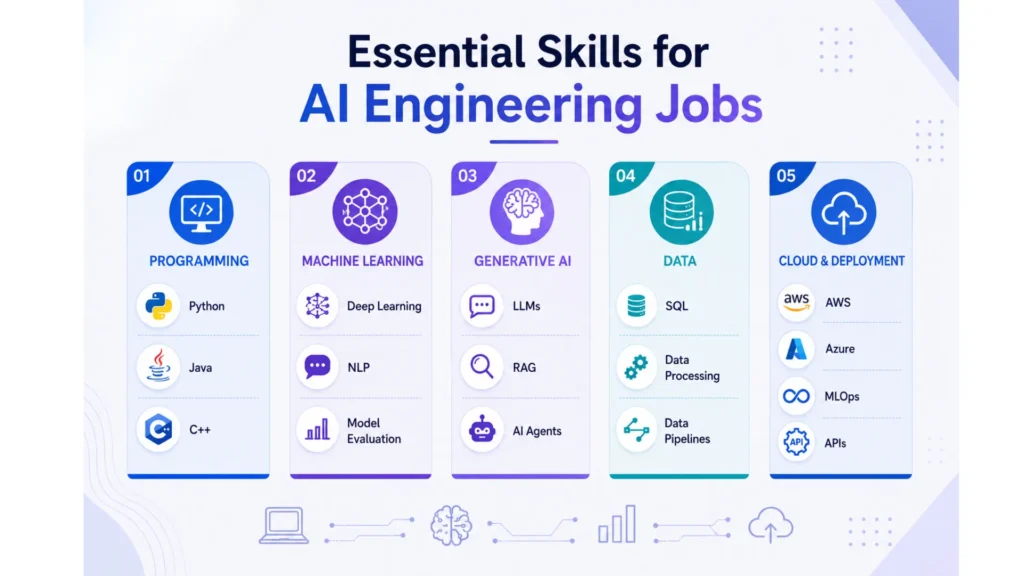
A successful AI engineer usually needs a combination of technical and problem-solving abilities.
Programming and Software Engineering
Strong programming fundamentals are essential. Python is particularly important across machine learning and AI development, while languages such as Java, C++, or JavaScript may be valuable depending on the application.
AI engineers should also understand:
- APIs
- Git and version control
- Software testing
- Data structures
- Algorithms
- Application architecture
- Deployment practices
AI engineering is not simply about training models. The systems around those models also need to be reliable and maintainable.
Machine Learning Skills
Understanding machine learning concepts is another important foundation.
Relevant areas include:
- Supervised and unsupervised learning
- Model evaluation
- Feature engineering
- Deep learning
- Natural language processing
- Computer vision
- Model optimization
- Machine learning pipelines
Candidates don’t necessarily need to master every specialization. The right combination depends on the AI developer roles they want to pursue.
Generative AI and Large Language Models
Generative AI has created another important area of specialization.
Professionals may work with:
- Large language models
- Retrieval-augmented generation
- Prompt engineering
- AI agents
- Embeddings
- Vector databases
- Model evaluation
- AI application development
However, knowing how to use an AI tool is different from understanding how to build reliable AI applications. Employers increasingly need professionals who can evaluate outputs, manage data, integrate models into software, and consider reliability and security.
Data Skills
AI systems depend heavily on data, making data science and AI closely connected.
AI engineers benefit from understanding databases, data pipelines, data cleaning, SQL, APIs, and data processing. Depending on the role, knowledge of tools such as Spark, cloud data platforms, or specialized machine learning frameworks may also be useful.
This type of role-specific positioning is also important when understanding how we customize every resume before applying.
Do AI Engineers Need Strong Software Engineering Skills?
Yes. This is one of the most important distinctions for people entering the field.
An AI model is only part of an AI product. Someone still needs to connect the model to applications, manage data, monitor performance, handle errors, improve reliability, and deploy the system.
Recent industry research also suggests that AI is changing software development rather than simply eliminating the need for developers. A 2026 World Economic Forum article citing developer research found that many developers reported expanded career opportunities from AI, while a large share expected their roles to change further.
This creates opportunities for software developers who develop AI capabilities rather than abandoning their existing engineering foundation.
What Career Paths Are Available in AI Engineering?
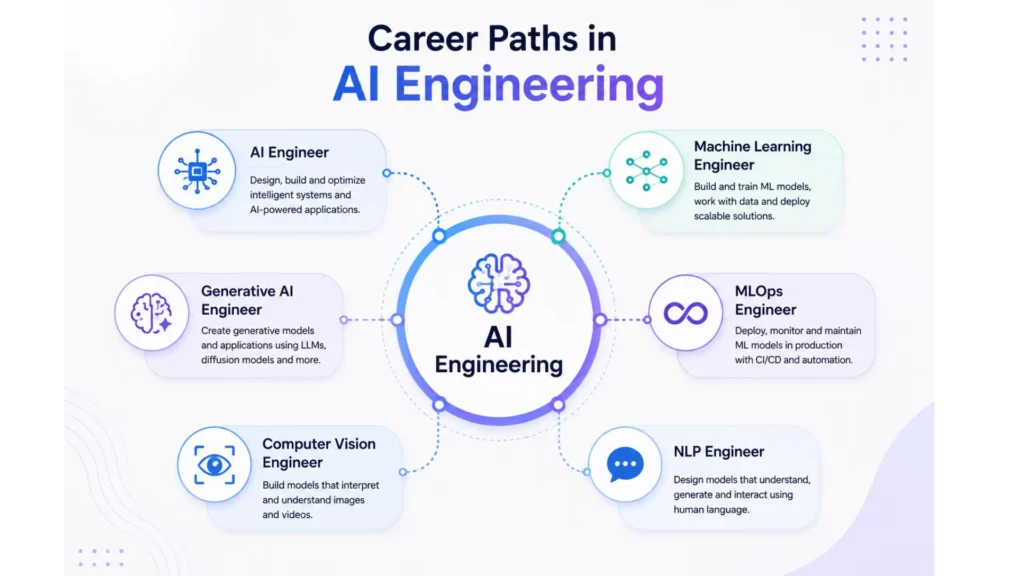
AI engineering is a broad field, so professionals can specialize in different directions.
AI Engineer
AI engineers build and integrate AI capabilities into applications and business systems.
Machine Learning Engineer
Machine learning engineers focus more heavily on developing, deploying, and maintaining machine learning models and pipelines.
Generative AI Engineer
These professionals specialize in building applications around generative models, large language models, AI agents, and related technologies.
AI Platform or MLOps Engineer
These roles focus on the infrastructure, deployment, monitoring, and operational processes required to run AI systems reliably.
Computer Vision Engineer
Computer vision specialists develop systems that interpret images, video, and other visual information.
NLP Engineer
Natural language processing professionals work on systems that understand, analyze, or generate human language.
These roles can overlap significantly, particularly at smaller companies where one professional may handle several responsibilities.
Which Industries Are Hiring AI Talent?
AI opportunities are expanding beyond traditional technology companies.
Potential employers include:
- Technology and software companies
- Financial services
- Healthcare
- Professional services
- Education
- Manufacturing
- Automotive
- Retail
- Telecommunications
- Energy and utilities
The World Economic Forum reports that AI and big data skills are expected to increase in importance across multiple industries, while AI-related roles are emerging in areas such as healthcare and information technology.
This means job seekers should not limit their search to companies that describe themselves as AI companies. A healthcare organization developing predictive systems or a financial institution building AI-powered services may also need AI engineering talent.
What Qualifications Do You Need for AI Engineering Jobs?
There is no single qualification that guarantees an AI engineering position.
A bachelor’s or master’s degree in computer science, artificial intelligence, data science, mathematics, engineering, or a related field can provide a strong foundation. However, practical experience is increasingly important.
A strong candidate might demonstrate experience through:
- AI or machine learning projects
- Software development experience
- GitHub repositories
- Internships
- Research
- Cloud-based AI applications
- Open-source contributions
- Relevant certifications
For career changers, building practical projects can help demonstrate skills that aren’t yet reflected in professional experience.
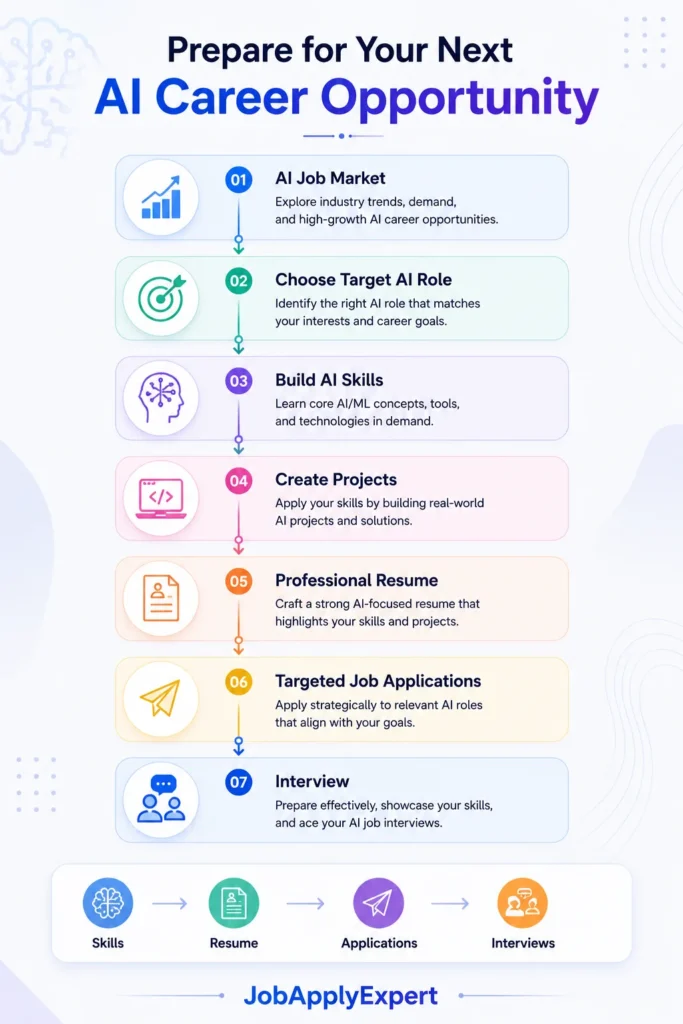
How Can You Prepare for AI Engineering Jobs?
If you’re planning to enter the field, avoid trying to learn every AI technology at once.
Instead:
Choose a target role. Decide whether you’re more interested in AI engineering, machine learning, generative AI, MLOps, NLP, or computer vision.
Strengthen your fundamentals. Build programming, mathematics, data, and software engineering skills.
Build real projects. Create applications that demonstrate how you use AI to solve practical problems.
Learn modern AI tools. Develop familiarity with LLMs, AI APIs, model evaluation, and deployment practices relevant to your target role.
Develop human skills. Analytical thinking, adaptability, communication, and collaboration remain important. The World Economic Forum identifies analytical thinking as the most sought-after core skill and expects creative thinking, resilience, flexibility, and lifelong learning to remain increasingly valuable.
Keep learning. The technology is changing rapidly, so continuous learning is part of the career rather than a temporary preparation stage.
How JobApplyExpert Can Help You Prepare for AI Engineering Jobs
Understanding the growing demand for AI professionals is only one part of building a successful technology career. Job seekers also need to communicate their technical abilities clearly and make sure their applications are aligned with the roles they are targeting.
An AI engineer may apply for several different roles, which is why one resume is not enough for every job application.
JobApplyExpert helps job seekers prepare for the hiring process through professional resume writing, resume customization, job application support, and career consulting. For candidates targeting AI Engineering Jobs, this can be useful when they need to present technical skills and projects in a way that is relevant to specific job opportunities.
An AI professional may have experience with Python, machine learning, large language models, cloud platforms, APIs, or data engineering. However, simply listing these technologies on a resume doesn’t always explain how they were used. A stronger application connects those skills with practical projects, responsibilities, and measurable results.
For example, instead of writing:
“Knowledge of Python, machine learning, and AI.”
A stronger resume statement could be:
“Developed Python-based machine learning solutions for automated data classification and evaluated model performance to improve prediction accuracy.”
This approach gives recruiters a clearer understanding of both the candidate’s technical skills and practical experience.
JobApplyExpert can also help candidates tailor their resumes to different AI-related positions. An application for a Machine Learning Engineer role may need to emphasize model development, Python, machine learning frameworks, and data pipelines, while a Generative AI Engineer position may place greater emphasis on LLMs, RAG, APIs, prompt engineering, model evaluation, and AI application development.
JobApplyExpert provides Professional Resume Writing Services that can help candidates present their technical skills, projects, and achievements more effectively.
The goal isn’t to add every AI-related keyword to a resume. Instead, candidates should highlight the skills and experience they genuinely possess and connect them to the requirements of the specific position.
Candidates who are unsure whether to pursue AI engineering, machine learning, data science, or another technology path may also benefit from Career Consultant Services.
Building a Stronger AI Job Application
If you’re preparing for an AI career, consider focusing on three areas:
Build relevant skills. Develop programming, machine learning, data, cloud, and AI application skills that match your target role.
Show practical experience. Use professional projects, personal projects, internships, research, or open-source contributions to demonstrate what you can actually build.
Present your experience strategically. Customize your resume and job applications so recruiters can quickly identify the technologies, achievements, and qualifications most relevant to the position.
For candidates who want additional support with this process, JobApplyExpert’s professional resume writing and job application services can be part of a broader strategy for approaching the AI job market.
Once your resume and career direction are ready, Job Application Services can help make the application process more organized and targeted.
How Should Job Seekers Position Themselves for AI Roles?
Technical ability needs to be communicated clearly during the job search.
Your resume should show more than a list of AI tools. Explain what you built, which technologies you used, what problem you solved, and what result you achieved.
For example, instead of:
“Worked with machine learning and Python.”
Use something more specific:
“Developed a Python-based machine learning model to automate customer classification and improved prediction accuracy through feature engineering and model evaluation.”
The second example provides evidence of practical capability.
If you’re applying to different AI Engineering Jobs, customize your resume for each position. An MLOps role may prioritize cloud infrastructure and deployment, while a generative AI role may emphasize LLMs, RAG, APIs, and application development.
Candidates should also understand what makes an ATS-friendly resume so that relevant technical skills and experience are presented clearly during the application process.
If you’re targeting technology positions, our guide on How to Write a Professional IT Resume provides practical advice on presenting technical skills, projects, achievements, and certifications.
The Future of AI Engineering Jobs
The growth of AI engineering is likely to continue as businesses move toward more AI-enabled products and workflows. The U.S. Bureau of Labor Statistics projects strong growth across several AI-related occupations, including a 33.5% increase in data scientist employment from 2024 to 2034 and a 19.7% increase for computer and information research scientists.
At the same time, AI engineering will continue to evolve. New roles may emerge around AI agents, AI infrastructure, governance, evaluation, safety, and human-AI collaboration.
The most resilient approach is therefore not to learn one AI tool and stop. Build transferable technical foundations and keep adapting as the technology changes.
Final Takeaway
The rise of AI Engineering Jobs is creating opportunities across software development, machine learning, data science, cloud infrastructure, cybersecurity, healthcare, finance, and other industries.
The strongest candidates will combine programming, machine learning skills, data knowledge, AI literacy, software engineering, and human problem-solving abilities.
For job seekers, the opportunity is real, but so is the competition. Building practical projects, developing relevant skills, understanding the AI job market, and clearly communicating your experience can help you position yourself for the next generation of artificial intelligence careers.
Frequently Asked Questions About AI Engineering Jobs
What qualifications are needed for AI Engineering Jobs?
A degree in computer science, AI, data science, mathematics, engineering, or a related field can be useful, but practical skills and project experience are also important. The specific requirements vary by employer and role.
What are the most important skills for an AI engineer?
Important skills include Python and software engineering, machine learning, data processing, model evaluation, cloud technologies, APIs, and AI application development. Communication, analytical thinking, and adaptability are also valuable.
Is AI engineering a good career in 2026?
AI engineering offers strong career potential as organizations continue adopting AI technologies. The World Economic Forum identifies AI and Machine Learning Specialists among the fastest-growing roles through 2030, although opportunities and requirements vary by industry and location.
Which industries hire AI engineers?
AI engineers can find opportunities in technology, financial services, healthcare, professional services, education, manufacturing, retail, telecommunications, energy, and other industries adopting AI solutions. AI hiring is increasingly spreading beyond traditional technology companies.
How can I get started in an AI engineering career?
Start by choosing a target AI career path, strengthen your programming and machine learning fundamentals, build practical projects, learn relevant AI technologies, and create a portfolio that demonstrates what you can actually build. Tailoring your resume to each AI role can also help employers quickly identify your relevant skills and experience.

 Sep 09, 2026

